
DVD-quality lessons (including tabs/sheet music) available for immediate viewing on any device.
Take your playing to the next level with the help of a local or online resonator guitar teacher.
Monthly newsletter includes free lessons, favorite member content, resonator guitar news and more.
Premier Sponsors


|
Please note this is an archived topic, so it is locked and unable to be replied to. You may, however, start a new topic and refer to this topic with a link: http://www.resohangout.com/archive/57886
Dallasblues - Posted - 04/25/2023: 09:44:34
Howdy all. I’ve played round neck resonators for years. I currently gig weekly with my ‘31 National Style-O playing mostly pre-war blues, bottleneck slide, and trad-jazz… occasionally Western swing too. I play it traditionally (not flat on lap) and most often I’m tuned to open G (DBGDGD), open D (DAF#DAD) or standard tuning. Lately I’ve been wanting to expand my knowledge and sliding/steel skills and am considering investing in a square neck reso. For my tastes, a metal bodied tricone would be most likely for the swing and trad jazz I often play. I’m also interested in learning some Hawaiian music too. Obviously a National would fit the bill but I’d also consider some more budget friendly import options such as Republic or Recording King.
Whichever guitar I decide to get I’d like to move beyond the tunings I currently use. Which is the preferred tuning for a metal bodied resonator playing trad-jazz and Western swing? Also, what strings would I need?
Thanks!
MarkinSonoma - Posted - 04/25/2023: 11:29:44
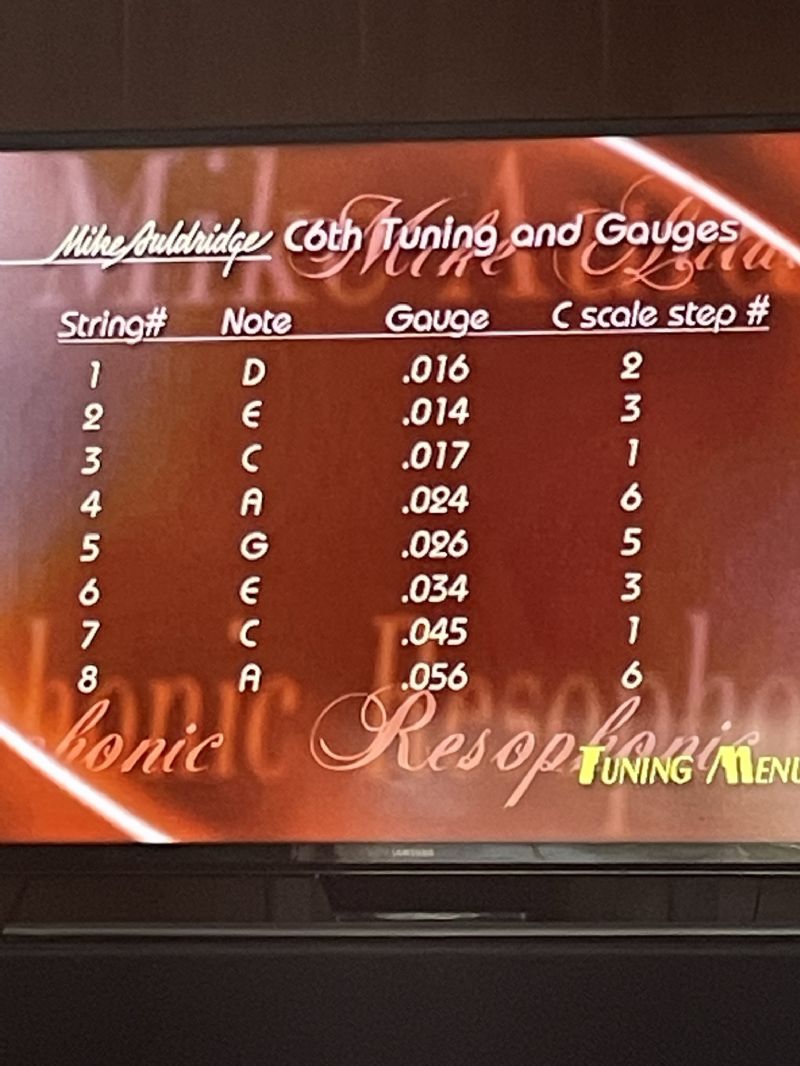
The classic tuning that works well for both swing and Hawaiian is C6, though the string gauges are on the lighter side and may or may not "load" the cone (or cones) enough to be pleasing to the ear, especially coming from playing roundneck in Open D and Open G. So it is most often used on electric lap steel. In the photo below is a screenshot from an 8 string instructional DVD from the late great Mike Auldridge. You can use the gauges on strings 2 through 7 to now become strings 1 through 6, low to high: CEGACE
Mike had a .026 for the G, most of us prefer .028w nowadays for that note so that the string will last longer.
There are a few members here who play C6 on a reso, they may have different ideas for some of the gauges.
Edited by - MarkinSonoma on 04/25/2023 11:32:00
MarkinSonoma - Posted - 04/25/2023: 11:41:00
Another tuning is G6 - this will load the cone/cones and give a "beefier" sound.
A regular dobro set for G tuning is the ticket, though you will want to sub out the 4th string for something lighter, like .034w or even .032w.
What you're doing here is raising the 4th string from D to E, so it will be low to high, GBEGBD. The beauty of this tuning is that you can "toggle" back and forth between G6 and high bass G major, GBDGBD. For that matter with these gauges you can play low bass Open G lap style with the same tuning as your roundneck.
Another tuning based on G is essentially Em7. Our friend and excellent player Greg Booth uses this as his regular tuning with a standard dobro set: EBDGBD
There are a lot of other tunings out there used by swing and Hawaiian players and it would take all day to list them. Particularly on swing and Hawaiian tunings, it's like opening up a can of worms. I highly recommend the book Slide Rules by Andy Volk. Andy also has a lot of teaching books with tablature available in different tunings.
volkmediabooks.com/products-bo...ide-rules
Edited by - MarkinSonoma on 04/25/2023 11:50:36
Dallasblues - Posted - 04/25/2023: 12:30:39
quote:
Originally posted by MarkinSonomaThe classic tuning that works well for both swing and Hawaiian is C6, though the string gauges are on the lighter side and may or may not "load" the cone (or cones) enough to be pleasing to the ear, especially coming from playing roundneck in Open D and Open G. So it is most often used on electric lap steel. In the photo below is a screenshot from an 8 string instructional DVD from the late great Mike Auldridge. You can use the gauges on strings 2 through 7 to now become strings 1 through 6, low to high: CEGACE
Mike had a .026 for the G, most of us prefer .028w nowadays for that note so that the string will last longer.
There are a few members here who play C6 on a reso, they may have different ideas for some of the gauges.
Thank you so much! Please forgive my ignorance. When I look at how C6 is tuned I'm scratching my head a bit. I can't tell if some of the strings are tuned way above where they'd be in a standard tuning or way below. For instance the C on the first string seems like it'd be really low... almost slacking, whereas the E on the second string would be crazy tight... on the verge of breaking. I'm assuming specific string gauges are used? Also I'm guessing a squareneck is better prepared to handle these varying loads versus my vintage roundneck (no truss rod).
MarkinSonoma - Posted - 04/25/2023: 13:11:19
Go back and read my last post - I listed the tuning as low to high. The C is the 6th string. The CEG on the bottom gives you the major triad. The ACE in strings 3, 2 and 1 give you the minor triad.
I should have discussed the 6th string, I did in a similar topic a few weeks back - just forgot about it today.
The .045w 6th string tuned to C is not slack at all on a guitar with a 24-25 inch scale length. In fact, on a 25 inch scale it's really tight. In G tuned dobro the typical 5th string in a set is a 45 or 46 tuned to B, and it's still tight enough to use as a cheese slicer. When tuning that string up a half step to C, to be on the safe side you may even want to drop it down to a 44 or even 42. A lot depends on the individual guitar's scale length and tuning machines. On an electric lap steel the gauges for C6 are significantly lighter on the lower strings since the amp is doing the work of handling the volume rather than having to load a cone on resonator guitar.
The 4th string E that Mike used is definitely very tight. It's why I mentioned the possibility earlier of using a .032w instead. I don't go back and forth from D up to E on my "A Game" Clinesmith resonator unless I put a .032w on the 4th string. It normally stays in Open G and sometimes D, but with a .036w on the guitar. When I have done the back and forth between D and E in the past, even with a lower gauge .034w on there it has exploded a couple times.
MarkinSonoma - Posted - 04/25/2023: 13:19:28
To hear some beautiful Hawaiian music played on a spider bridge dobro, check out the late Barney Isaacs with guitarist George Kuo. The whole album is on YouTube these days.
I have the CD - I should try to find it among my bazillion CDs to see if the string gauges are listed in the booklet.
Dallasblues - Posted - 04/25/2023: 14:54:47
quote:
Originally posted by MarkinSonomaGo back and read my last post - I listed the tuning as low to high. The C is the 6th string. The CEG on the bottom gives you the major triad. The ACE in strings 3, 2 and 1 give you the minor triad.
I should have discussed the 6th string, I did in a similar topic a few weeks back - just forgot about it today.The .045w 6th string tuned to C is not slack at all on a guitar with a 24-25 inch scale length. In fact, on a 25 inch scale it's really tight. In G tuned dobro the typical 5th string in a set is a 45 or 46 tuned to B, and it's still tight enough to use as a cheese slicer. When tuning that string up a half step to C, to be on the safe side you may even want to drop it down to a 44 or even 42. A lot depends on the individual guitar's scale length and tuning machines. On an electric lap steel the gauges for C6 are significantly lighter on the lower strings since the amp is doing the work of handling the volume rather than having to load a cone on resonator guitar.
The 4th string E that Mike used is definitely very tight. It's why I mentioned the possibility earlier of using a .032w instead. I don't go back and forth from D up to E on my "A Game" Clinesmith resonator unless I put a .032w on the 4th string. It normally stays in Open G and sometimes D, but with a .036w on the guitar. When I have done the back and forth between D and E in the past, even with a lower gauge .034w on there it has exploded a couple times.
Ahhh. You are correct. I read that backwards. That makes more sense! Thank you.
wlgiii - Posted - 04/26/2023: 07:53:23
Two more cents, with some repetition from past posts:
My Regal tricone did fine for years before a National upgrade, so I support Regals. It's a round neck but I did from time to time put on a nut lifter and play lap style. A cone upgrade will also help. I never did on this but did for my Regal biscuit. (I've also toyed with the biscuit lap style to get a different sound.)
As for tuning- I have a 8 string dobro in C6; I haven't had issues with the lighter gauge strings, but may be the exception rather than the rule. I went with that instead of G6 or A6 to suit our singing keys.
Terms of Use | Privacy Policy | Privacy Consent (EU/GDPR Only)
Copyright 2026 Reso Hangout. All Rights Reserved.


