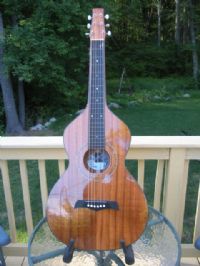
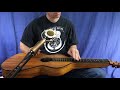
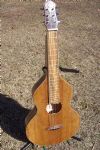
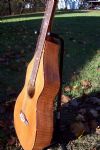
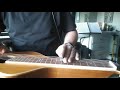
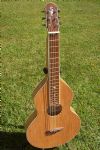
I plunked my money down to have Bill Hardin make me one of his MK Weissenborns, which is a once-in-a-lifetime thrill for me. So, I want to get it as right as I can. I'm driving to his shop in the next month to pick out the koa. Last night at an Ed Gerhard concert (oh my GAWD, where do those sounds come from? There were moments I had no idea what I was hearing - it LOOKED like a Weiss, but sounded otherworldly), he casually mentioned that you always pick out 2 sets of top wood, in case the luthier messes one up. Makes sense to me. What other advice do you have for me about choosing the koa?
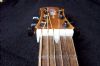
Bill also asked me what string spacing I want. I've read a lot about this, here and elsewhere. I've measured the instruments I have (Gold Tone SM, Beard R, Oahu squareneck). I can figure out what spacing is comfortable for me, but I'm confused by the discussions I've read about how string spacing affects playing slants. There seem to be 3 camps: those who advocate parallel strings with the same spacing from nut to saddle, and those who think having tighter string spacing at the nut is the way to go. The third camp says scale length is the most important factor (the MK's is 25"). I'm not sure how much any of this matters; it seems that hearing and muscle memory are what wins the day when it comes to intonation. What's your experience with how string spacing affects slanting ease?
8 Comments |
 | Grizz says:
7/31/2011 9:26:11 AM
I wish I could answer you but never having had a custom guitar built I can't be of any assistance. I play my instruments the way they come. I am thinking like you, how much does it really matter or is it just basically fodder for conversation. I mean how wide can they make it? It will be interesting to hear the responses. I am sooooooooooo jealous. I would love to see Ed live. I have seen video and listened to a lot of people play the Wessie, and this is my opinion. He entices a sound out of this instrument like no other. When he said about Wessie's "there is a broken heart in every one" he puts it there. If only !!!!!!!!!!!!!
|
 | Gitman44 says:
7/31/2011 7:37:05 PM
Hi Liz,
I'm with Grizz, I've never had the chance to have a custom guitar built. But I do a lot of reading about it for if/when I get the chance to. :-)
The consensus, or close to that, from what I've read, is that the less figured koa sounds better than the highly figured specimens. Perhaps Tony Francis can provide his thoughts (Tony, are you there?). Ask Bill Hardin, too. I love flamed koa, but it's all about the sound..
Regarding string spacing, what tuning do you use on your Weissenborn? If it's DADF#AD, there's not a whole lot of slants being done (like in C6th). If it were me, I'd stick with the spacing used on the original Weissenborns built in the 20's. They've passed the test of time and still sound great after all these years. I'm pretty sure the one Ed Gerhard plays is a rather plain grained koa Weissenborn close-to-original copy, and listen to the magical sounds he gets out of it. It's all about the sound.... Good luck Liz. I envy you..
Andy Fekete
|
| Grizz says:
7/31/2011 8:49:28 PM
Actually I think you nailed it Andy. The MK model is not highly flamed. Look at the photo for our group. Actually Hermann made three "styles". Bottom line there was no "style" other than how fancy do you want it. We think the word style in different terms. Yup, it's about the sound, no more, no less. Read below
WEISSENBORN STYLES
Most Weissenborns were made of koa (some early examples have bird's-eye maple backs and sides), 39 inches long with a 25-inch scale, 15-1/4 inches across the lower bout and 10-1/4 inches across the upper bout. They were made in four styles of trim: Style 1 instruments have no body or fingerboard binding. There are three concentric wood circles inlaid around the soundhole, and single mother-of-pearl dot markers at frets five, seven, nine, 12, and 17. "Bat-wing" bridges with metal saddles were standard on all Weissenborns. Spruce tops were optional (but rare) on Styles 1 and 2.
Style 2 instruments have black celluloid tops and back body binding, rope binding (termed "clown binding" by David Lindley) around the soundhole, white wood fingerboard binding, fancier fret markers in various patterns, and sometimes a first-fret triangle with its flat side resting against the nut. (Interestingly, this feature also appears on square-neck Style 3 and 4 tricone resonator guitars. Collector and luthier R.C. Allen recalls conversations he had with the late John Dopyera, inventor of the National and Dobro, in which he said that his brother, Rudy, had once worked for Hermann Weissenborn.) Style 2 fingerboards have a French curve overhanging the soundhole (the other three styles are squared off).
Style 3 Weissenborns feature rope binding around the top, fingerboard, and soundhole; usually a diamond inlay at the 12th fret; and double dots at frets five and nine. Style 4 is similar to Style 3, with added rope binding around the peghead and back, and a triangle inlay between the nut and the first fret. Some examples have sanded braces and internal wood surfaces.
|
 | Liz Williams says:
7/31/2011 9:46:25 PM
Thanks for your replies, everyone. I'll talk to Bill about this and see what he recommends. I've heard that the straighter koa sounds better too, but I doubt there's a causal connection. The Weissenborn Ed Gerhard played last night was highly figured koa - bling city! I'll keep you all posted as this goes along.
|
 | Tony Francis says:
8/3/2011 2:40:03 AM
Hi Liz, Andy.
My advice would be to work with Bill on this - there are many variables in the design and construction of any instrument.
As far as the Koa grades, the curly or more highly figured (and often darker) Koa grows at higher elevation. This wood is more dense, and that will shape what the luthier does with it and so shapes the voice of the instrument.
The softer, lighter wood is from lower elevation, and that's the simple Koa grain you see on a lot of the Style 1 and 2 Weissenborn guitars. Because of the lighter density, the tops are thicker and what the player hears is more sustain, and a sweeter woody tone which is what some people prefer.
Its like choosing between two kids in the same family. You really need them both!
|
| Grizz says:
8/3/2011 7:16:48 AM
Wow, this is so cool. Nothing like hearing it from the masters. Thanks Tony.
|
| Gitman44 says:
8/3/2011 8:27:41 AM
Thanks for the insight Tony. That "sweet woody tone" is what Weissenborns are all about. There's nothing prettier than a highly flamed Koa guitar, but to me that tone will always win over looks. It's all about the sound....
By the way, Liz, someone's listed a nearly new Asher Style 4 on ebay. Looks like a beauty. Thought I'd mention that in case your wanting to get your luthier-built Weissenborn sooner. :-)
Thanks everyone...
Andy Fekete
|
| Liz Williams says:
8/6/2011 7:24:43 PM
Thanks, Tony. It seems what's most important is knowing what sound I want, and talking that over with Bill. As for string spacing, the wider the better for me. I find really wide sptirng spacing eliminates pick noise.
|
Post a Comment
|
You must be logged in and a member of this group to post a comment.
|