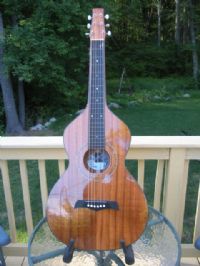
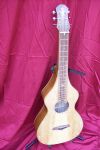
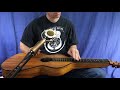
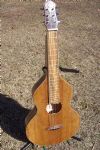
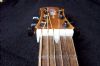
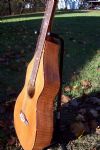
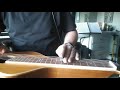
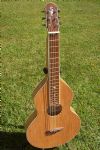
Over the years I've had the opportunity to play a bunch of different Weissenborn guitars and there's one thing that always been a bit of a mystery to me. I'll be the first to admit that I am not an expert on the history of Hermann Weissenborn and his guitars, the different eras of manufacture, etc, but of the 15+ different vintage guitars that I've played the best sounding/playing guitars were the "plain jane" style 1 models. The more ornate models, especially style 3 and style 4 guitars, while beautiful to look at, but were relatively bass heavy and couldn't hold a candle to the style 1s. I have a friend who went through a period of buying vintage Weissenborns and had the same experience as me. After owning maybe 4-5 different vintage Weissenborn's he sold them all and kept his style 1 as his main guitar. That guitar looks and plays the same as my mid-1920's style 1. It's pretty sweet!
I'm curious to know if anyone else here has had similar experience with vintage Weissenborns? Does anyone have any insights as to why there are sonic/playability differences between the different models? As crazy as it may I'm thinking it might have something to do with the different grades of wood used to make the different models. Maybe the less figured wood used for style 1 guitars came from a different part of the Hawaiian islands? If that theory turns out to be bogus, I'd be curious to know how the design and construction of the different models changed over the years? Maybe Hermann started using heavier bracing after the mid-1920's, making the later models more bass heavy and less responsive?
14 Comments |
 | Liz Williams says:
11/3/2012 5:07:27 PM
Ooo - I can't wait to hear what Tom now has to say about this. In a fairly recent thread here, he did talk about how later Weissenborns were built heavier, but I don't recall him addressing the Style 1 vs 3 and 4 issue.
|
 | Tom_Noe says:
11/3/2012 6:46:24 PM
Let's see if we can clear up some of the mystery here, Rob. Generally speaking, and in my opinion, the Golden Age for Weissenborns was 1922-1926. They were lightly braced and had long sustain (21-24 seconds in my empirical tests), while the heavier braced 1927-1936 models damped out pretty quick in comparison, 9 to 14 seconds of sustain in my tests. Also, in the 1923-1926 period, the factory turned out mostly Style 1s and 4s, with few 3s and almost no 2s. My best sounding Weissenborn is a 1923 Style 4. I have a friend whose best sounding is also a Style 4. Other factors that contribute to (or detract from) the sound is grain density and pattern, and the finish. Oil varnish was used in the early days and gave way to shellac, and finally lacquer. The notion that koa from the wet side of the island was better than koa from the dry side is an urban myth that was debunked by the Guild of American Luthiers in 1994, which pointed out that woods of all grains and densities could be found within the same grove of acacia trees. And in any case, it is doubtful that Hermann knew which side of the island his koa wood came from. All that said, there really isn't a bad sounding Weissenborn--some just sound better than others and it is up to the individual ear to discern what is pleasing.
|
RobA says:
11/4/2012 4:27:46 AM
Tom,
Thank you so much for helping to solve this mystery! I can't begin to tell you how much I appreciate this! You rock!
Now that mystery is solved it raises new questions such as why did Hermann switch to heavier bracing in 1927? I am guessing there was/is a direct correlation between bracing and the durability/lifespan of the instruments? One of the best sounding style 1's I ever heard was a guitar I played at Gruhn's Guitars in Nashville. The bridge looked it was about to pull off of the guitar but it sounded amazing. Didn't someone at the factory notice the before/after difference in sustain?
One other question - I would like to use medium gauge strings on my vintage style 1 for the additional string tension, but I've shied away from doing so out of fear of damaging the guitar. Instead I use light gauge strings (.012 - .056) and replace the 1st and 2nd strings with a .014 and .017). My guitar has a couple of cracks on the soundboard which look like they've been repaired. I use medium gauge strings on my Tony Francis guitar and I love the extra string tension. Do you have any sense for where to draw the line on string tension for vintage Weissenborns?
Thanks again Tom. I'm so glad you are a member of this forum!
|
| Tom_Noe says:
11/4/2012 9:59:55 AM
Rob,
The changes in 1926-27 were all about increasing the volume. Resonator guitars introduced in 1926 began supplanting Weissenborns in band settings. Rudolph Dopyera had a falling out with his brothers, and when Hermann's son, who was sort of the shop foreman, died in suddenly in July 1926, Rudy was hired as the new shop foreman. He immediately began to experiment with ways to increase the volume of Weissenborn guitars. I have seen photos of a Weissenborn with a resonator cone, and a fellow in California has one with a built-in sound horn from this era. But what they settled on was to reduce the bridge thickness by 25% so heavier strings could be used, and heavier bracing, part of which is a massive maple bridge plate that extends up into the X bracing where the braces cross and down to below the bridge. The post 1926 Weissenborns can easily be spotted by the smaller bridge.
The fact that Weissenborn went to heavier strings in 1927 says that you don't want to go too heavy on a more lightly braced guitar, but medium gauge strings would be okay as long as you don't tune to open A. I have a couple of friends that swear by medium gauge D'Addario phosphor bronze strings, but replace the first string with a .014 like you do. I have found Bill Asher's Acoustic Hawaiian strings (medium gauge--.014 to .056) to be pretty good, but my favorite are the Newton Alohas which have been discussed in this forum. They will handle a low-bass G tuning, but as an ex-Dobro player I generally tune down one full step to open F or use a D tuning. Some strings are just too light and you wind up with a "tinny" sound. By the way, I should be getting my new Tony Francis guitar any day now. It is a solid-neck replica.
|
RobA says:
11/4/2012 10:07:21 AM
Thanks Tom, I really appreciate your insights into the history of the Weissenborn! I'll give medium gauge strings a try!
Respect!
|
RobA says:
11/4/2012 10:16:15 AM
Forgot to mention - glad to hear you are in line for one of Tony's guitars. There are so many great builders offering contemporary Weissenborn guitars but what sets Tony apart is his attention to detail in faithfully replicating Hermann Weissenborn' original design.
I think of my vintage Weissenborn and Tony Francis style 1 as equivalents. In fact, I'd go as far to say that Tony guitars are built better than the originals. The only real difference is the age of the guitar.
My style 1 is definitely mellower than my Tony Francis guitar, but Tony's guitar plays better and is way more responsive. Both guitars sound amazing!
|
RobA says:
11/5/2012 3:47:15 AM
Tom, thanks for sharing the photos of your solid neck style 4 guitar by Tony Francis. That's one sweet looking guitar!
Now I'm curious: much of what I've seen written presents the hollow neck construction as being the main reason for the Weissenborn having its "magical" tone. How/why did you decide to commission Tony Francis to build a replica of a solid neck Weissenborn? By the way, who is Red? What are the sonic differences between a solid neck and hollow neck Weissenborn, all other things being equal?
|
| Liz Williams says:
11/5/2012 6:26:20 AM
Great questions, Rob. I want to know too. If Tom can't answer, maybe Tony will stop by and enlighten us.
|
| Tom_Noe says:
11/5/2012 8:06:16 AM
Wow, Rob, what you ask entails a lo-o-o-o-ng story, so I will try to keep it brief. The solid-neck Weissenborns are extremely rare, and I know the other five people who have one. I got mine from Red Bowers, a sweet old guy who had a vintage guitar shop in Post Falls, Idaho. When I first saw and heard a Weissenborn in 1987 (it was a Style 1), I began to search for one. They just didn't exist. But every vintage dealer I would tell me that Red Bowers has a Style 4, but he won't sell it to you, let alone even show it to you. But after owning the guitar for 23 years, Red sold it to me to help fund an Alaskan cruise. I played it that night in a Couer d'Alene hotel room, and then put it away because it was pristine and like a brand new guitar and I wanted to preserve it that way. Fast forward to March 2010. A fellow in California purchased an early pre-production Weissenborn on eBay, and out the case dropped four photographs. They were all taken in 1922 at the home of August Mayer, Hermann Weissenborn's bookkeeper. Featured in the photos is Concepcion, Hermann's wife, playing a solid-neck with Style 3 appointments. Concepci was just 5'1" and it dawned on me that the solid-neck, which is smaller than a standard Weissenborn, was designed specifically for her. Only a handful were made, all with either Style 3 or 4 appointments and were the first Weissenborns to have rope binding, and it was never a production instrument. I shared the photos with Tony Francis, and we immediately collaborated replicate a solid-neck, using the Red Bowers solid neck as a prototype. Tony is the master, and he has done an incredible job in re-creating this instrument. When I get it, I will pull the Red Bowers solidneck out of storage, set it up, and compare the two. My apologies for bandwidth I've consumed.
|
RobA says:
11/5/2012 8:24:30 AM
Apologize? Are you kidding, this is a great story! What about the sonic differences between the solid neck and a standard hollow-neck Weissenborn?
|
| Tom_Noe says:
11/5/2012 9:13:38 AM
All I can remember from 1993 is that Red's solid-neck sounded great, but I had nothing to compare it with. I will do that when I get the Tony Francis re-creation! Can't wait!
|
 | Seabass says:
11/5/2012 10:26:43 AM
Thanks Tom for all that very interesting information! And thanks Rob for asking some questions that have come up to my mind a couple of times before...
|
| Tom_Noe says:
11/11/2012 8:55:55 AM
For those of you who ask about the sound of the solid-neck and what to see photos, I invite you to vist tonyfrancisinstruments.blogspot.com
|
| Liz Williams says:
11/11/2012 8:46:37 PM
Tom, those pictures are even more gorgeous than the ones Tony first sent. What a gift your dedication is, to Tony and to all of us. Thank you.
|
Post a Comment
|
You must be logged in and a member of this group to post a comment.
|