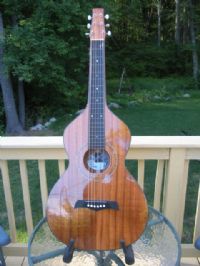
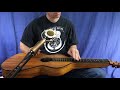
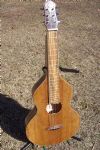
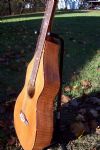
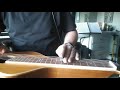
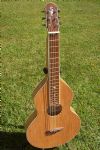
I know there are a few hollowneck players that use Open Dm tuning. I have messed with it a bit in the past, but it never really clicked for me. I have usually prefered DADF#AD or DADGAD.
Was just messing around this week and tuned the weissie to DADFAD. I was shocked at how great it sounded. The combination of the three melody strings and the bass strings really lent itself to some beautiful runs and chords. As a minor tuning, it is definitely better suited for more reflective songs.
I am still not setup to record myself with anything other than my phone. But will hopefully be able to post some examples.
Anyone else like this tuning on their weissie?
Casey
17 Comments |
 | Liz Williams says:
12/15/2012 10:17:51 AM
Thanks for this, Casey. My experiments with D minor on the hollowneck haven't clicked for me. although I found the tuning beautiful. Maybe I didn't give it enough time. I'm encouraged to hear that you have found a sweet spot with it. I hope our other members will chime in on this and that you'll all post some examples of your playing.
|
 | CaseyHunter says:
12/15/2012 3:24:31 PM
I don't normally post my own recordings. I seem to have an aversion to the mic. As soon as it turns on I forget how to count and play all together. With that said this recording is no exception, it has a ton of mistakes but is about as good as I am going to get it today. I am just noodling around in Dm. I think I may need to slow it down and let the weissie breathe a bit more.
soundcloud.com/hollowneck/slide-in-dm-1
Speaking of recordings, i started recording musical thoughts some years back as i would stumble onto interesting ideas. I started to record them because I would forget them. It is fun to go back through them and see if I can still play them and if they were any good. Sure beats writing out tab.
Casey
|
| Liz Williams says:
12/15/2012 4:16:46 PM
Casey, that's just noodling around? I loved it! So tuneful and lovely and interesting. I listened several times and will listen again. Thank you for posting it. I hope you'll post more of your music.
|
RobA says:
12/18/2012 3:06:21 AM
Nice noodling Casey!
Just to add to the discussion and answer the question you posed - I like the sound that you get out of the Dm tuning and I can see where it could be just the ticket for establishing a certain vibe, etc. Now, I'll be the first to admit that I don't have any experience with Dm tuning, but it would seem to me that the big drawback is the lack of versatility. Are there ways to invoke major chords in the tuning or does everything wind up being centered out of a minor tonality? In standard D tuning (DADF#AD) you get a beautiful, rich sounding Vim, power chords galore (which can sub for minor chords) and a variety of ways to invoke other chord inversions. Please post some more of your stuff - I'd be interested to hear more with the Dm tuning!
|
| CaseyHunter says:
12/18/2012 8:33:35 AM
Thanks Liz and Rob.
I have to admit I am a sucker for the minor chords and scales. They are what I hear in my head most of the time when I think of the Weissenborn based songs. There is nothing like a broken heart Weissenborn adding tension with the minor chords.
Rob, these are some great questions. I am very limited in my chord composition and scale knowledge, but I will give it a shot.
Minor chords and scales are something I have always struggled with while in (DADF#AD). I can never get a strong full sounding minor chord, only the power chord alternates. I know a lot of this is my inexperience and lack of music theory. I need to study more of the chord and scale composition, and I am sure it would open up more possibilities.
Skip James played a lot of his songs in open Dm. He seems to have found a balance with the tuning. He has a different style of playing, but still in the same sonic range.
I have always given up on the Cm and Dm open tunings in the past, simply because if felt very limited to the minor tones. I think it does have some limits as far as full chords go. From what I can tell, you still have the same power chords and major chords (if you exclude the 'F' string). They just don't sound as full. The 'ah ha' moment for me was in the melody strings. What I lost in chord options was made up for me in the melody strings (DFA). The F string is better behaved for me than the F# string. Meaning, the scales come easier as soon as I dropped the F# down to F. I honestly have found that I avoid the F# string in Open D when playing scales, runs, etc. This is primarily because it forces me to think in half steps instead of full steps. I am getting better at using it, but I tend to struggle with it still.
Another thing I noticed, which may just be my lower end Weissenclone, but by dropping the F# to F, I noticed that I lost a bit of sustain across all of the strings. I am assuming this is related to the tension, but don’t know for sure. I can still get some nice sustain, but you really have to milk the string with the bar. By reducing the sustain, it seems to have helped clean up the notes on the individual strings. Making it sound more like a finger style instrument.
Another tuning to consider, in all this is the Open Dm7 (DADFAC). This tuning definitely adds to the complexity of the chord and also is a bit harder to use the slide with. However, it has some very wonderful tones and possibilities. I still am working getting my head wrapped around the 7ths.
I only get to play about an hour a week due to work. If I get a chance I will try to pull together some additional recordings.
Casey
(By the way, if anybody's BS alarm went off, let me know. I know very little of what I am talking about.) :)
|
| Liz Williams says:
12/18/2012 10:02:00 AM
Casey, what a delight you are! My BS alarm didn't go off once I spend 4 years in college studying music theory. I spent the last 12 years playing middle eastern frame drums which do not play well with western instruments. Some of my favorite jams were with a fiddle/mando player who was tuned in open fifths. It was a different sonic universe.
I'm really intrigued by the sonic possibilities of the Weiss. I'm itching to spend some time with these tunings and see if I can get them to play well with frame drum. Please post more of your experimenting/noodling as you have time - it's ear candy to me.
Thanks to you and to Rob for digging into this topic.
|
RobA says:
12/18/2012 10:10:46 AM
that does it Liz - you gotta post a clip with something played in the Dm tuning!
|
| Liz Williams says:
12/18/2012 10:50:28 AM
AHHHH! You're right Rob, crummy playing and all - I'll do it.
Just spent a little time noodling around in Dm7 with itanpura (iphone app) in the background. Mostly pretty awful, but some interesting snippets too. Got the drum tuned to D (more or less) up here. too. Fun!
|
RobA says:
12/18/2012 3:53:06 PM
Casey:
Just a thought - one of the main ways to invoke those mournful "broken heart" intervals in a major tuning (like DADF#AD) is to use the root strings as a drone and play in the zone between major and minor 3rds, 7ths as well as flatted 5ths. Some folks refer to these as microtones, I think of it milking the emotion out of the space between the notes. Just to be clear, if its a bluesy, mournful number I don't come remotely close to playing a major 3rd, for example, but it isn't a pure minor 3rd either. Ry Cooder's Paris, Texas is a great example of this. In the opening line of the song he plays off between a slightly flat and then slightly sharp m3 using D tuning. One of these days I'm going to figure out how to notate this sort of thing in TablEdit. For now I'm completely stymied by this!
|
RobA says:
12/18/2012 5:19:30 PM
Oops forgot to add some important detail in my post above:
By play in the zone I should have been more specific - as in play those notes with the bar while using open D strings as a drone
|
| Liz Williams says:
12/19/2012 8:54:52 AM
Rob, this is helpful. There goes another entire afternoon! Several afternoons. Of course you will be posting an audio clip of your noodling on these very tones? ;-)
I'm working on making a recording that doesn't sound like I'm in a barn. By the weekend, I'm sure I'll get it.
|
RobA says:
12/19/2012 6:57:42 PM
Now there's an offer (or should I say challenge) that I can't refuse! It might take me awhile, but I'll see what I can come up with and I'll post it
|
| Liz Williams says:
12/19/2012 9:34:53 PM
Yay! It's a post-a-thon!
|
| CaseyHunter says:
12/20/2012 6:58:35 AM
Rob, thanks for the advice. Definitely going to sit down and see if I can figure it out. I would love to see your technique to do this. Can't wait for yours and Liz's recordings.
|
RobA says:
12/22/2012 5:45:52 AM
Here's a clip of my Weissenborn rendition of Paris, Texas by Ry Cooder. I shot this for a group class that I was teaching earlier this year. It's impossible (at least for me) to duplicate or even get close to the expressiveness and tone that Ry Cooder gets out of his guitar. Now he's playing the tune bottleneck style, so that's part of the reason, but he is one of the greats and the tone and expressiveness is "in his hands" so I can only try to approximate the emotions that this tune is trying to communicate.
Anyway, this tune has a definite "dark" minor/bluesy vibe to it and it's a great tune to work up on Weissenborn. On the one hand it's not hard to play, not a lot of motor notes like a fast bluegrass fiddle tune, but it's very demanding in terms of learning to play with precise intonation and a convincing vibrato. This is in standard D tuning - DADF#AD
youtu.be/6pMzFCeIHXA
|
| Liz Williams says:
12/22/2012 10:30:46 AM
I marvel at your intonation, tone and expressiveness, Rob. Delicious! Ry Cooder has jaw-dropping magic, but your version sends me. And I see what you mean about messing with the 3rds in particular. Thank you for the link.
|
RobA says:
12/23/2012 5:17:33 AM
Thank you Liz, you're too kind!
|
Post a Comment
|
You must be logged in and a member of this group to post a comment.
|