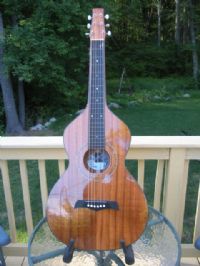
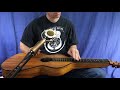
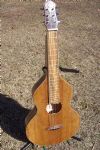
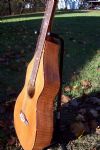
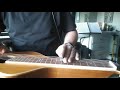
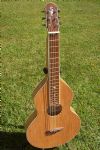
as there are not so many books/dvds out there dealing with lap steel playing and techniques or methods to improve one's playing, I just thought we probably could share our experiences here. I often find myself playing the same old songs that really don't let me move forward in the sense of letting me improve and come to a "new level" (I don't play in a band, just for myself at home). When I first started playing, it took me a while being able to alternate the thumb on the bass strings and improvise on the treble strings. But after a while I was able to do it and that really opened up so many possibilities. I can really recommend practicing that to any weissenborn beginner. Is there anything else that you can recommend or that you find very important to improve your general playing or technique?
- What about scales for example, is it any helpful to practice scales (to get better in improvisation maybe?!). I started doing that but I'm not quite sure if it will get me anywhere...
- Another thing I thought of was to buy a Looper to record some guitar playing and then improvise with the weissenborn.
18 Comments |
 | TheKrowe says:
1/5/2013 2:43:13 PM
As with any instrument I've played, with the exception of the hammered dulcimer, I warm up with 45-60 minutes of scales. On these slideways guitars I do open and closed scale practice. I use open scales to practice hammer-ons and pull-offs. I practice closed major, minor, blues, pentatonic major, and pentatonic minor scales all over the neck. After that I'll spend the next hour or more stumbling over the next piece of music I'm trying to embrace.
Why such a rigorously disciplined approach? It's the way I was raised. When I started first grade I also started (kicking and screaming) piano lessons. From the very beginning I was taught the discipline of scales and warm up excercises. It served me well as I was able to play selections from Mussorgsky's Pictures At An Exhibition at my senior recital. I'm a very simple person. I find a method that works and apply it over and over again. Except that hammered dulcimer...
|
RobA says:
1/5/2013 2:59:40 PM
I'm a big fan of the idea of "focused practice." For example, for one person, practicing might refer to playing through a bunch of scale patterns or rolls while watching tv, whereas focused practice would be practicing G major scale open position scale notes as triplets with a metronome at 100BPM with a goal of increasing to 110BPM.
|
 | Bob Blair says:
1/5/2013 3:00:02 PM
Any instructional material out there on the D tuning (I understand, for example, Troy has done something) would transfer over. There are some people who have done some great stuff for lap steel - Chuck Lettes, Mike Neer and I think Roy Thompson as well. The D tuning is not all that prevalent among electric non-pedal players though. Outside of blues, a lot of the stuff that is out there for lap is going to be geared to swing or old-time country (but Mike Neer has done at least one be-bop course).
Their is such a small group of Weissenborn players that instructional material is not going to be easy to find (if there is any I've never encountered it). With reso, it seems like a lot of the new players share an interest in learning their way around the bluegrass world. Weissenborn does not really have a genre - it tends to not fit in too many ensembles and we all seem to play whatever we feel like playing on it (which is one of the great things about the instrument).
Scales are really important to spend time on. The idea of making yourself some guitar tracks to play with is a great idea also.
Kevin Brown emphasized to me the importance of being able to do a nice steady alternating thumb (between the sixth and fourth strings mostly) and that is something that is worth spending a lot of time on. Kevin has a lot of great ideas for Weissenborn, including alternate tunings that D can easily be changed back and forth with, and there is a whole world of music that he plays. He may be the msot versatile weissenborn player out there, and certainly one of the best. I'm not sure that he has written a course or whether he has or would give Skype lessons but to my mind, and with the experience of one lesson with him in Dallas last year, I would recommend him as a leading weissenborn guru. Great guy too. thekevinbrown.com
|
| Bob Blair says:
1/5/2013 3:02:06 PM
Rob Anderlik - also a leading light. How could I forget?!?! I'm assuming Rob that if you had created any study material for weissenborn you would have mentioned it?
|
| TheKrowe says:
1/5/2013 3:34:01 PM
Kelly Joe Phelps has a decent video on Homespun. My only complaint is that he capo's up to F for the lessons. What the heck? Bob Brozman also has a couple of applicable videos, but he gets over my playing ability real quick. Troy Brenningmeyer has some open D material on his site that I've found useful.
|
 | CaseyHunter says:
1/5/2013 7:22:35 PM
I haven't used these, but thought they may help for someone looking to improve. Especially since they are lessons for the weissenborns. From what I can tell he is a Canadian guitarist that also plays lapsteel.
Steve Dawson:
Hawaiian style lessons
learnrootsmusic.com/html/SDDVD02.html
C tuning lessons
learnrootsmusic.com/html/SDDVD01.html
it is a strange tuning but has an interesting sound.
|
RobA says:
1/6/2013 7:58:05 AM
Bob - at this point I am offering some tabs of my tunes and/or Skype lessons. At some point I will start offering video tutorials, maybe sometime later this year. That said, I think Seabass' original question was about effective practice methods...
It goes without saying that there are many different styles, approaches and techniques to playing the Weissenborn. For example, Kelly Joe Phelps and Bob Brozman both play the Weissenborn but they draw from very different musical sources and have developed a different bag of tricks/techniques. Both great players but very different. I've found that its usually best to try and learn from the players who you admire as a starting point.
For me some of the greatest satisfaction and advancement in my playing has come from learning to play the songs of my musical hero's by ear. The first Weissenborn tune I ever heard was David Lindley's tune - Look So Good. It's a very simple melody; the whole song is about 1 1/2 minutes long. My main method for learning to play by ear has always involved using a slow down device of one kind or another. In the old days it was a $300 Marantz cassette player, these days I use a software program called Transcribe. Anyway, Once I figured out the tuning I got the main part of the melody down pretty quickly but it took me forever to figure out how he played the Vim chord! I can laugh about it now, but I spent months trying to figure out how he got that sound! Once I figured it out I thought I had died and gone to heaven! With the advent of the internet and especially You Tube there are countless people offering instructional advice, etc, but nothing can replace the hard work of training your ear to decipher chord progressions, intervals, scales and arpeggios and developing the ability to play those things on your instrument.
The other method that I've found helpful for learning to play by ear is also one of the most effective means of developing general musicianship skills and that is to get out of the house and play with other musicians. Playing with other musicians - especially good musicians - is foundational to developing basic skills on multiple levels - it forces you to adapt to someone else's sense of timing, learn to think on your feet, find something to compliment what the other person is playing, not to mention that learning your way around the instrument - playing in different keys, finding rhythmic parts and/or melodies to new songs and last but not least - developing the right hand strength to "cut" through the mix.
If its the case that you don't aspire to play with other musicians, let's say you are only interested in playing solo material, one of the best ways to grow is to get out of the house and start performing at open mics or coffee houses, etc. Either way - playing with other musicians or performing in front of an audience - will do more to advance your playing than going through the same routine of practicing at home. If you're experience is anything like mine there will be high points and low points. My experience is that frustration is an important and necessary element in the learning process for musicians - it's usually 10x easier to play through something in the comfort of your living room than it is in front of an audience, etc. The important thing is to get out of your comfort zone and play in front of an audience - even if it's a tiny coffee house - or play with other musicians. The frustration that I've experienced in those kinds of situations has definitely motivated me to work that much harder to improve!
In addition to the above I've found it helpful just to realize that 80% of a players tone come from their right hand; from their right hand position, the size of their hand, how they attack the strings, and the economy of motion. There are exceptions of course, but the reason the greatest players make it look so easy and can play amazing runs at breakneck speed without breaking a sweat is because they've trained their hands to play with great economy of motion. Not that the left hand isn't important - it plays a huge role in articulation and intonation with the bar - but in my experience the right hand techniques have been the most challenging to learn. The main components of good right hand technique - at least for me - are the ability to mute/block, balancing right hand fingerings between thumb (downstrokes) and 1st/2nd fingers (upstrokes), and play rolls/arpgeggio's without thinking about them. All of this stuff has to be internalized, committed to muscle memory before it can become effortless. In my own experience, I've found working on rolls/arpeggios to be particularly effective in developing right hand strength and dexterity.
Hope this helps!
|
 | Seabass says:
1/6/2013 9:28:41 AM
Thank you all so far for your great feedback!
Rob is right, "effective practice methods" is actually what I'm looking for and as a german guy wasn't able to express in english :) I got many ideas from all of your postings, thank you for that.
Interesting to hear that other players (TheKrowe) also had to go through painful piano lessons, starting with scales in all variations :) I was never quite sure though if that really helped me progress. But maybe I just didn't realize that it got me any further but it actually did. However, as one of my problems is that I have trouble remembering where the notes on the neck are in the areas where I don't play a lot (especially in the areas higher than the 5th fret), scales might be a useful practice. Any recommendations on how to start? I would probably just pick one key and then play the scale in various positions on the fretboard ....? Since my Weiss is tuned to open-d: are there any scales that I should focus on as they are more important than others when playing with that tuning (Sorry, my music theory skills are not the best...)?
Playing in front of an audience or with other musicians is an important point. I guess Rob is right and it can really bring you to a higher level because you have to concentrate much more to avoid mistakes that wouldn't bother you if you were at home playing by yourself. I notice that when I sometimes play just for fun with a friend who is a pretty good guitar player. I should probably do that more often.
Bob and chunter4, thanks for your postings and recommendations of DVDs and lap steel players, I will certainly check them out. I already own the DVDs of Kelly Joe Phelps and Bob Brozman and they both teach some nice tricks. After a while, I got bored though, practicing the same stuff on and on so I started this topic here to get some new ideas :)
Just like Rob, I usually try to learn new songs by ear (also because there are not many complete and precise tabs out there for many lap steel songs). I am currently practicing KJ Phelps' song "Hobo's son" which is the hardest piece I've tried to play so far...maybe I should use the Transcribe software program to slow it down a litle... :)
|
 | SMUSSLIN says:
1/6/2013 11:11:08 AM
I've been takinglessons for 4 months now. I've found that what has takin me to a higher level is constantly practicing different rolls with a metronome. When I do them I bounce around using the "circle of fifths" creating my own little tunes. Also YouTube has been very helpful finding things I like and then working parts out with my ear.
|
| TheKrowe says:
1/6/2013 11:18:49 AM
This morning I was feeling the effects of the disability in my hands a little more than usual, so I decided to do some "strength training". I did an hour of playing nothing but simple forward rolls over 3, 2, 1 and 4, 3, 1 (dobro tuning), beginning at 60 bpm in 4/4 working my way up to 120 bpm. Then I switched to 6/8 and wore myself out. Though I never touched bar to string, I held the Smith the entire time to help strengthen my left hand as well. We don't often think of playing an instrument as an athletic endeavor, but it truly is. It requires physical training to gain proficiency.
Rob is spot on with his recommendation to play out at every opportunity. Loosely quoting one of my early heros, Duane Allman, "nothing hones your chops like going on the road."
As far as which scales to work on first, the answer is in the strings. There's three of them tuned to D, so that's your starting point. Remember, that thumb spends a lot of time alternating between 6 and 4. So, here is what I would suggest...
D maj.
D min.
D melodic min.
D harmonic min.
D pentatonic maj.
D pentatonic min.
D blues
G mixolydian
C dorian
A lydian
The three modes recommended are commonly used in blues, jazz, and rock, and all start on D for the key of C.
Not trying to sound like an advertisement for Homespun, but they offer a lesson called Ear Training for Instrumentals, that starts with simple interval recognition drills, and takes you all the way through to hearing several measures of music and being able to repeat in on your instrument. I picked it up in the 80's when it was distributed on cassette, and it really helped me to unravel the Irish music I was playing at the time. Homespun is having a sale on their downloadable products through the 8th. Use discount JAN2013. If you really want to learn by ear, this will help.
|
| Bob Blair says:
1/6/2013 11:37:29 AM
Rob's comments about finding the Vim in "Look So Good" reminded me that I was sitting way up in a gallery looking straight down on the stage at Lindley shortly after I started fooling with the weiss, and could see how he was getting it (in "Brothers Under the Bridge") and rushing home to try it. Rob has generously posted a video of "Look So Good" which will spare a lot of people the frustration of figuring out how to get that all-important chord!
In terms of practice I find that a lot of the scale work I do on G-tuned reso helps me out a lot in the D tuning.
|
 | Randy H says:
1/6/2013 11:49:25 AM
I'm happy this subject came up. I'm laboring on deciding what Troy lesson to download first. I'm hoping the open D alternating thumb lesson would be as goo as any to start with.
|
| Seabass says:
1/8/2013 10:47:06 AM
@TheKrowe: What do you mean by saying "Remember, that thumb spends a lot of time alternating between 6 and 4"? Sorry, maybe it's a stupid question, but do you alternate the thumb on string 6 and 4 while playing the scales? Thanks for a short reply.
By the way, I don't know if you all know this website already, but I find this scale locator pretty easy to use:
hawaiiansteel.com/scalelocator/basic.php
|
 | jacknj says:
1/8/2013 11:22:30 AM
Thanks for the link to the scale locator.
|
| TheKrowe says:
1/8/2013 11:27:19 AM
Lots of country blues tunes (which is where my head is stuck lately) lay out well when played with D as the root with an open D tuning. When you're on the rood cord, the thumb often alternates rhythmically between open 6 and open 4 while the fingers catch the fills and melody. It wouldn't hurt to play scales (D) between the alternating base strokes.
|
| TheKrowe says:
1/8/2013 11:37:05 AM
Scale locator is cool. Thanks for that!
|
| Seabass says:
1/8/2013 12:10:02 PM
OK, TheKrowe, thanks, I got you now! :)
|
Post a Comment
|
You must be logged in and a member of this group to post a comment.
|