


Are there advantages of memorizing the notes of the fingerboard compared to learning only with tablature?

Instead of memorizing all the notes in all of the fret positions, I recommend:
1. Learn scale "intervals". What makes a major scale major and a minor scale minor.
2. Learn what chords are built around major, minor, etc. scales and how those chords are built.
3. Discover where those scale and chord pieces work in your tuning of choice and recognize where those "pockets" can be found on your neck.
Sounds daunting but in reality, easier than one thinks. For much of the music and discovery you'll be doing in the near term, all you need to do is be able to count to "8". It's this plus a tiny bit of theory and you'll be on your way to discovery.
The beauty is all you need are the basics above and you'll soon realize that the patterns. pieces, numbers, etc. work in EVERY key the EXACT same way.
Good luck in your journey.
hp

Thanks your reply, and for this "The beauty is all you need are the basics above and you'll soon realize that the patterns. pieces, numbers, etc. work in EVERY key the EXACT same way"
This is what I am trying to get in my head. I do need some of that basic music theory. Good thing to focus on, let the journey begin anew!
Best
Great post by Howard, excellent suggestions.
Over the years I have learned the Nashville Number System, highly useful.
But I'm also an advocate for learning the note names. And as far as that goes I will also use the word daunting - as in learning the names of all the notes on the dobro fretboard isn't as daunting as learning them on standard guitar tuned to EADGBE. With high bass Open G you only need to learn three strings since the GBDGBD tuning repeats itself an octave apart.
I could write a really long post about the "features and benefits" of knowing locations of the notes on the fretboard, but I'll spare you of that.
On the other hand some phenomenal musicians know very little about note locations and and theory. We were finally able to see the late great Jeff Beck in concert in Oakland about nine years ago on a bill with Brian Wilson.
Beck flat out blew me away (and Brian Wilson began blowing me away as an 8 year old kid in the early '60s). I recall an interview with Beck many years ago where he said that he had very limited knowledge of the guitar fretboard. It didn't seem to stop him from becoming an amazing guitarist.
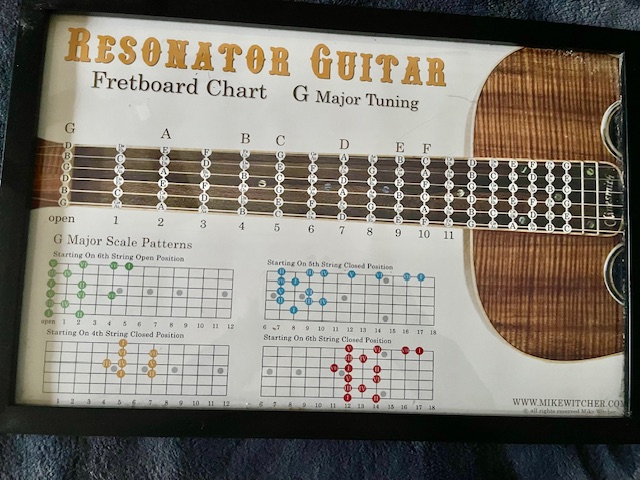
For myself, knowing the note names has been very helpful. I don't think Mike Witcher sells these posters anymore, unless he has some stashed at his house because they aren't on his website - fretboard charts for both G and D tuning, I have both in my office/music room. Checking them out on a regular basis is a little like the drills with math flash cards back in the elementary school days.
Aside from the note names you can see MIke put some scales on the bottom, but he uses scale numbers rather than note names.
I've seen a couple other versions aside from Mike's in the past online, so they're out there.
Click on the photo to enlarge.
Edited by - MarkinSonoma on 12/06/2023 12:36:41
FWIW - I wish I knew that better , and had earlier known what I do know now.
I am mostly attuned to things in relation to a particular fret position . But that's enough for me to sense that if I had more comprehensive fretboard knowledge, it would unlock a lot more for me .
We're all different. I only use tab to write down riffs I make up and want to remember. For playing, I use scales.
Not a pro, so I look for shortcuts. For major scales, a nice cheater trick is working off the IV and V chords. Like, for the key of A, working left and right from the seventh and ninth fret.
I do very little memorizing. Not my talent. Improvising usually gets me through.
You will notice... on the standard guitar tuning... EADGBE.. the second note of each group is the root note of the cycle... for example, if you play in the key of A, the E note is the opposite of the A note and so on.
The GBDGBD tuning is similar except for the BD configuration...
Full fretboard memorization is worth it only if you have a thorough grasp on (and quick recall of) harmony.
I memorized every note on standard E roundneck non-reso. Did so by practicing George Van Eps’ method. It’s given me a really triad-based approach to music. (Triadic studies are more accessible as an entryway to learning harmony than the brutalist approach of memorizing thousands of chord shapes and variations.)
The short answer is no. Long answer is yes, but only if you also learn to manipulate harmony freely and readily.
Dobro leans so heavily on incorporating open strings into rolls that knowing the notes on the guitar (which are the same on dobro except for the high string being a step down and the bottom being octave repetitions of the top — easy carryover from roundneck standard E) has been really useful for me in thinking of interesting new ways to spell chords.
Come to think of it, it shouldn’t be impossible to catalogue triads in every key in every possible position on a dobro. Maybe one of these days I’ll get around to it.
I'm a beginner on reso but have played several other instruments (guitar, mandolin, whistle) and can read notation. The GBDGBD tuning is the first instrument where I can't really read notation and play, at least not yet. Things I've found...
It's more important to know the degrees of the scale than the names of the notes. Where are the 1, 2, b3, 3, 4, 5, 6, b7, and 7 notes for the key you are in? (the "b" means flat; one fret lower.)
Chord construction. A major chord is the 1,3,5 degrees of the scale. Minor is 1,b3,5. 7th is 1,3,5,b7. Those are the big three. And the notes don't have to be in that order. Also, you don't always have to play all the notes. Even two notes (a double stop) can suggest the chord.
Then where are the notes for a related chord when you are on the position of another chord. An example would be the I chord is a G and you have the bar on the twelfth fret. The song is going to D7 (the V7 chord) for a few beats. You could slidedown to the seventh fret. But, go down frets string and play the two highest strings. That's the 5 and b7 note of the D (V) chord. So you can play two notes of the chord very quickly by only moving the bar two frets. I'm starting to learn where pieces of chords like that are, and even only playing a couple months, I'm starting to be able to mix things up a bit instead of always putting the bar on the fret for the current chord.
I do what Howard said in post #2, ie, intervals, chord structure, and pockets/patterns.
I switch keys and tunings so much that memorizing the notes is not the most practical way to navigate.
Of course, some note knowledge just seeps in along the way, by virtue of knowing chord structure and scales…but it’s not my main compass.
Or maybe I’m just lazy…lol.
Jimmy Heffernans video, "Scales and how to use them", probably did the most to help me navigate the neck (still a work in progress). It's a movable closed posistion scale that works over all keys. If I'm playing over a C chord, I will start on the 5th fret, probably the root C and then move around to notes that are within a couple frets, up or down from the 5th fret. If I hit a note that doesn't please my ear, I keep sliding and call it a blues lick!
. . . Sounds daunting but in reality, easier than one thinks. For much of the music and discovery you'll be doing in the near term, all you need to do is be able to count to "8". It's this plus a tiny bit of theory and you'll be on your way to discovery. . . .
You'd think. But I have an easier time with guitar and mandolin scales.
Mandolin because (a) it's such a regular pattern and (b) the octaves are broken into two equal matching halves. Guitar because of the CAGED system: You learn the five interlocking bar chord patterns, and you're suddenly playing up and down th neck.
On squareneck, I have a hard time remembering where's what. It's getting better, but it's no cakewalk into town.
PS -
If you play flattop or electric guitar, you might've noticed that what Howard described fits what guitarists call the CAGED system: a way of learning shapes and patterns instead of notes.
I'll leave the discussion of usefulness to others and just say that no matter what you do you're gonna end up practicing scales, and if you just sing the name of the note along with those practices you'll have the full fretboard memorized in no time. I also like to do this with arpeggios etc.... Sometimes I will sing the numbers to get those into my head as well.
It isn't that much more effort that just playing scales and when you're ready to use the information it'll already be in you.
I have a fairly good understanding of the fretboard in EADGBE, but am not very sharp with GBDGBD.
I was in a workshop with Billy Cardine last Autumn. Billy advocates learning every note on the fretboard with the aim of playing arpeggios starting on any string. Using open G there are only three open string notes so it's not that difficult.
Likewise, there are three arppegio shapes per chord type. I will not publish Billy's worksheets here but it is also not hard to figure out. Here's some pointers for major chords.
G string - Straight bar;
B string is a zig zag shape;
D string is a diagonal shape.
Then try to play an arpeggio-based solo for a song like the swing classic "All of me". It has 9 chords and you can get do a lot within 2 frets, a bit more across three frets and a whole lot more once you know the arppegio and related scale patterns for each chords.
One shouldn't donate a whole practice routine to this! I pick a note each day, identify locations on each string, then arppegios, then scales. Perhaps I invest 10 min per day.
Edited by - PauSe on 01/25/2026 04:41:13
To my post above, perhaps the word triad is better than arppegio!
quote:
Originally posted by DogwoodAre there advantages of memorizing the notes of the fingerboard compared to learning only with tablature?
No doubt, but I don't do either. I just learn scale shapes and patterns. The visual approach.
quote:
Originally posted by DogwoodThanks your reply, and for this "The beauty is all you need are the basics above and you'll soon realize that the patterns. pieces, numbers, etc. work in EVERY key the EXACT same way"
This is what I am trying to get in my head. I do need some of that basic music theory. Good thing to focus on, let the journey begin anew!
Best
Hey, Dog!
Luckily (for me, anyhow), what Howard is describing is a way to learn how to get around a fretboard without having to understand theory.
On flattop guitar in standard EADGBE tuning, it quickly gets complicated because the down-tuning of that B string fractures all the patterns. That's why (a) so many guitar players rely on the CAGED system and (b) cowboy chord shapes seem so arbitrary.
But like violin and mandolin tuning, standard dobro tuning just repeats across all the strings and all the way up and down the neck.
When I started on squareneck, I drew diagrams of chord and scale patterns. Once you know some, all you have to do is move them up and down the neck to fit the key you're in or the chord you're on. All without delving into the higher math and heady heights of music theory.
Let us know how it goes. Operators are standing by!
Edited by - Charlie Bernstein on 01/28/2026 07:50:14
Terms of Use | Privacy Policy | Privacy Consent (EU/GDPR Only)
Copyright 2026 Reso Hangout. All Rights Reserved.

