


I am building my first dobro and don't want to make a sound well. I'll put in posts to support the cone along with a two ply ring to form the lip. My question is about the baffle. I have only seen one made of clear plastic and am wondering if I can just use wood to separate the upper and lower bouts? Is that going to work? Do I need a baffle, or can I do without one? Thanks for reading.

"Do you need" is up to you.
What characteristics are you trying to achieve?
What tone woods are you using?
Everything effects everything.
There are fine guitars using scoops/no scoops, baffles/no baffles, soundwells/no soundwells, completely open body.
Such is the way. Study. Experiment.

quote:
Originally posted by hlpdobro"Do you need" is up to you.
What characteristics are you trying to achieve?
What tone woods are you using?
Everything effects everything.
There are fine guitars using scoops/no scoops, baffles/no baffles, soundwells/no soundwells, completely open body.
Such is the way. Study. Experiment.
Thanks for your reply.
I am looking for a typical punchy sound with nice bass. The guitar will be all mahogany with a Beard original BC-1 cone, maple/ebony inserts, bone nut and #14 spider bridge, Gold Star soundhole screens, brass cover plate and tailpiece. Slotted headstock with Golden Age restoration tuners. Pearloid dots, White plastic binding. The scale length will be 27" meeting the neck at the 13th fret, with 0148 silver fretwire. The body dimensions are: 19-1/2" long, upper bout will be 10-1/2" wide and the lower but will be about 14" wide. I have both basswood and mahogany kerfing for this build. Bracing will be sitka spruce and mahogany. The fretboard and head plate will be granadillo.. I will be using tru-oil for the finish on the body and neck, or maybe shellac. I am thinking of using mahogany for the baffle if people with this experience think it would work. I hope I didn't forget anything.
Edited by - Mooooo on 03/18/2026 10:12:43
"typical punchy sound with nice bass".
I don't know what "typical" is.
FWIW... (there's no real "correct" answer). Part of the knowledge rests with the major builders of past & present. They each had a unique design & construction practices born of decades of experiments, successes & failures.
As far as I am aware, only one contemporary builder utilizes multiple internal designs and is able to build guitars with a variety of "voices".
Start with one guitar.
Build your guitar. See what works and what does not work.
And then...Build another one and learn from that.
Have fun. It's a journey.
h
Mooooo, how about adding at least your first name and where you live?
As far a forgetting something - you didn't tell us whether this will be a squareneck for lap style playing, or a roundneck for conventional playing.
My main guitar for many years has been a 2004 Clinesmith made from curly western big leaf maple. Post and wood baffle construction. The baffle appears to be made from the same maple. Plenty of punch and bass, but a little "mellower" than many guitars I've heard made from the typical eastern hardrock maple. Western big leaf maple grows along rivers and creeks up and down the west coast and is a little softer than other maples.
27 inch scale? Is this going to be a baritone resonator guitar?
quote:
Originally posted by MarkinSonomaMooooo, how about adding at least your first name and where you live?
As far a forgetting something - you didn't tell us whether this will be a squareneck for lap style playing, or a roundneck for conventional playing.My main guitar for many years has been a 2004 Clinesmith made from curly western big leaf maple. Post and wood baffle construction. The baffle appears to be made from the same maple. Plenty of punch and bass, but a little "mellower" than many guitars I've heard made from the typical eastern hardrock maple. Western big leaf maple grows along rivers and creeks up and down the west coast and is a little softer than other maples.
27 inch scale? Is this going to be a baritone resonator guitar?
Thanks for the reply Mark, my name is Mick, I live in central Illinois.
This is going to be a squareneck. And I plan on tuning to F for my vocal range and capo up to G if I need to learn something online. I figured adding that extra fret up top would be a good compromise. This is the first I'm hearing of a baritone dobro, but I guess it fits the bill.
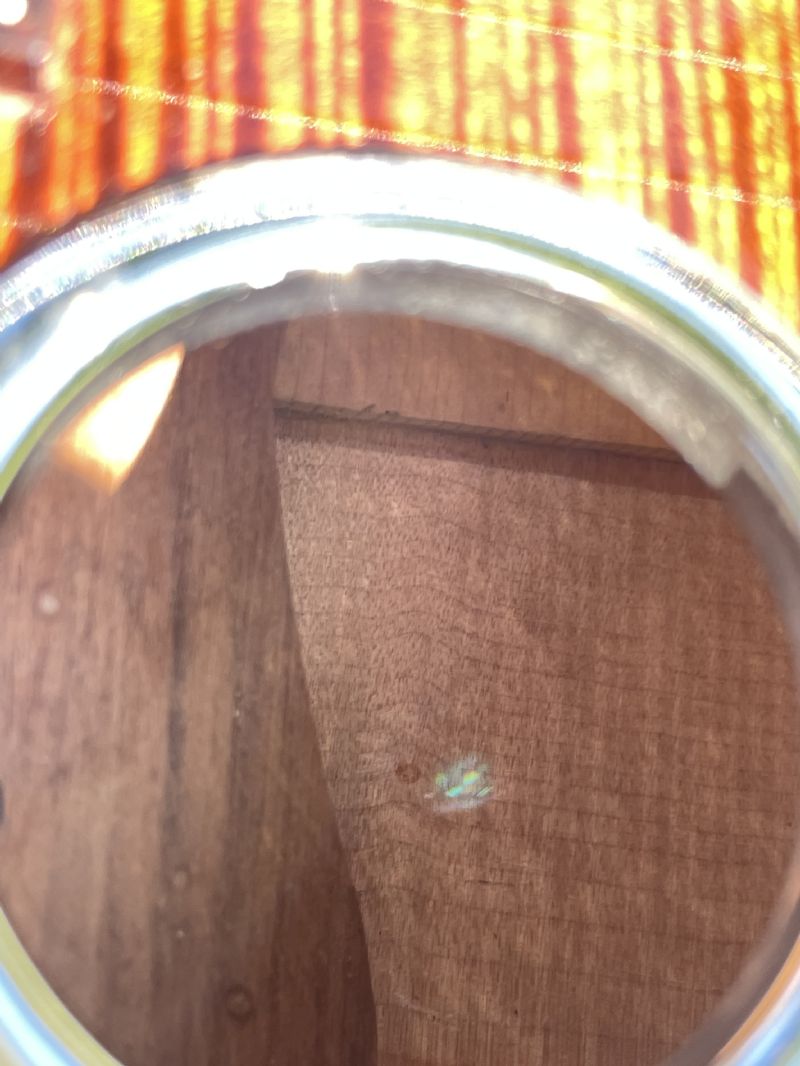
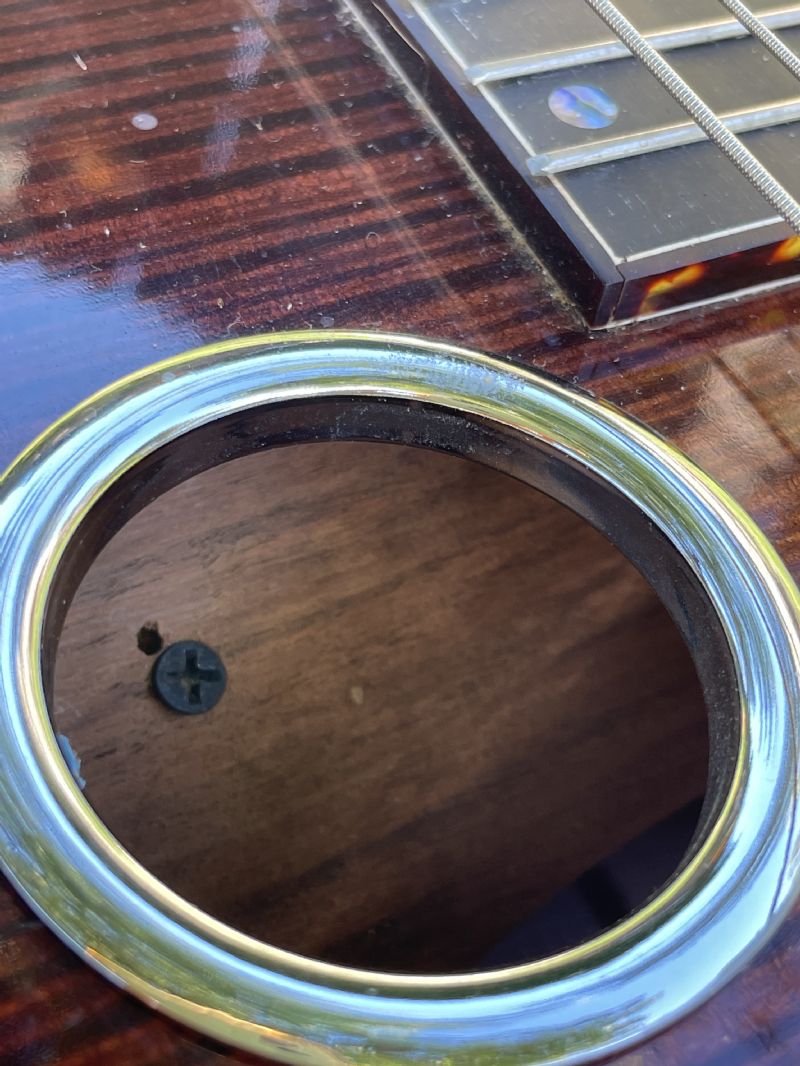
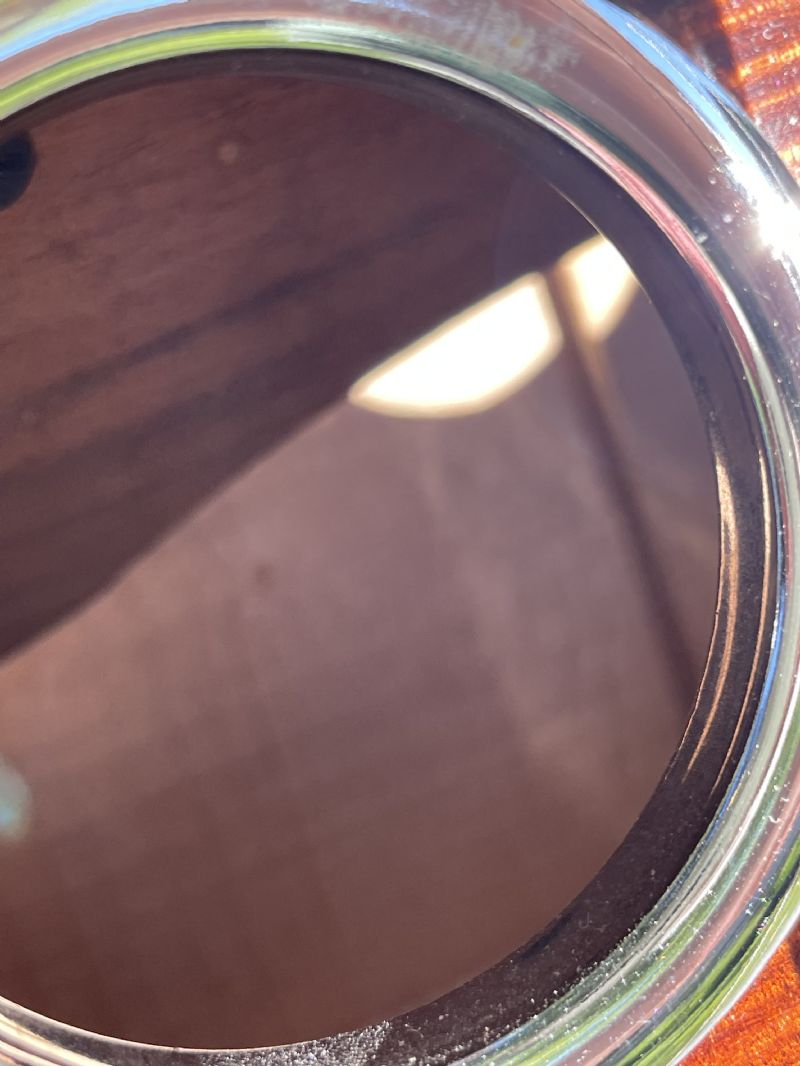
I am interested in the baffle in your dobro. Does it totally close off the upper bout area, or is it more of a wall with space on the sides or somewhere?
Edited by - Mooooo on 03/18/2026 13:07:49
Mick, I wil take a couple photos through the screen ring holes tomorrow during the day (Thursday) of Todd's wooden baffle and post them here.
And it would be a good idea to add your name and Central Illinois to your homepage so that it appears here when you enter a post. 
Sidebar regarding the 27" scale business.
I grabbed the following quote from Google AI re baritone guitar:
I of course have no idea how close you follow Jerry Douglas and his career as a member of Alison Krauss and Union Station. When Dan Tyminski was in the band, one of their big hits was Man of Constant Sorrow with Dan on the lead vocal. Jerry had a big a part in that song on dobro, and I saw them do it live nine or ten times over the years - it always got the crowd on its feet.
They did it in the key of F which I'm guessing is Dan's sweet spot vocally for the song. Rather than play it in a closed position, or capo to the IV chord in F on the 3rd fret/B flat, Jerry always had a dobro on stage tuned to FACFAC just for that one song so that he could get all the same licks as if he were playing in Open G. I've tuned to FACFAC a number of times for a song in the key of F because if it were a situation where it didn't have to be done like right now, it was nice to be able to re-tune my dobro to be able to use that tuning.
I have no idea if Jerry ever used different string gauges for F, but since in dropping the tuning one whole step I'm guessing he didn't. I have never noticed enough of a difference in tuning down to F where I though it would be worth it to change any strings on a typical 25" scale dobro. If tuning the guitar to F is your main deal, I can see where you might want to change some strings to get it really dialed in. As far as building a 13 fret guitar, I'm not enough of a luthier to know if that part of the equation makes a difference.
Food for thought...
Currently working on a baritone squareneck reso, 27" scale, it's the first one for me. My experience with baritone lap style guitars is the weissenborn style models. With the 27" scale, I had it tuned to Open A, same note to note relationship as Open D. Some tune to Open B. The body of the baritone reso is the same as a 25" model but with the 27" scale which looks like what Beard did with JD's baritone. Small note, the neck joins the body somewhere between the 13th and 14th fret with that setup.
quote:
Originally posted by MarkinSonomaMick, I wil take a couple photos through the screen ring holes tomorrow during the day (Thursday) of Todd's wooden baffle and post them here.
And it would be a good idea to add your name and Central Illinois to your homepage so that it appears here when you enter a post.
Thanks so much Mark, very kind of you to offer this. Please only do this if it won't be an inconvenience to you.
quote:
Originally posted by jacknjCurrently working on a baritone squareneck reso, 27" scale, it's the first one for me. My experience with baritone lap style guitars is the weissenborn style models. With the 27" scale, I had it tuned to Open A, same note to note relationship as Open D. Some tune to Open B. The body of the baritone reso is the same as a 25" model but with the 27" scale which looks like what Beard did with JD's baritone. Small note, the neck joins the body somewhere between the 13th and 14th fret with that setup.
Thanks for your post, it's very interesting to me. I wonder if you will have a baffle or a soundwell? I hope to see some pics when you finish your guitar.
The luthier I knew had a basket of dozens he took out of guitars being improved by him. No one complained.
I know he tried adjustable wells as well. But gave up.
His guitars were all post after some point.
This is the baffle design I use. Plexi attached to center of back plate and curves upwards to top, ending about midway to center area of F holes or screens(if used).
Tough to get good photos of the wood baffle in the Clinesmith without disassembling the guitar.
It comes down from an angle at the top toward the center of the guitar. Gentle curves on the edges with airspace on all sides, it's not a solid piece that goes all the way across.
Todd later abandoned the wood baffle and went with a clear plastic of some kind.
This guitar isn't particularly heavy for a reso, but no doubt a plastic baffle would lighten it up a bit.
quote:
Originally posted by jacknjThe body of the baritone reso is the same as a 25" model but with the 27" scale which looks like what Beard did with JD's baritone. Small note, the neck joins the body somewhere between the 13th and 14th fret with that setup.
I don't doubt that JD has one, because he posted on the old forum on his website in the early 2010s that he was up to around 60 guitars at the time, but I don't ever recall coming across a Beard baritone being played in a public performance.
Could a double shot be utilized to add an additional tuning to the F?
hangoutstorage.com/resohangout...32026.jpg
My baffle design.
quote:
Originally posted by skydogCould a double shot be utilized to add an additional tuning to the F?
Yes, but 1) it would be acting as a very expensive capo, since the tuning intervals are identical, 2) he'd be stuck with standard G tuning gauge strings, 3) if F is his home base, the lever handle would be disengaged as a default (for most of his playing), which is a tad annoying as it protrudes several inches.
IMO he's best optimizing for F tuning and capo'ing 2 for G when desired.
quote:
Originally posted by Moooooquote:
Originally posted by hlpdobro"Do you need" is up to you.
What characteristics are you trying to achieve?
What tone woods are you using?
Everything effects everything.
There are fine guitars using scoops/no scoops, baffles/no baffles, soundwells/no soundwells, completely open body.
Such is the way. Study. Experiment.Thanks for your reply.
I am looking for a typical punchy sound with nice bass. The guitar will be all mahogany with a Beard original BC-1 cone, maple/ebony inserts, bone nut and #14 spider bridge, Gold Star soundhole screens, brass cover plate and tailpiece. Slotted headstock with Golden Age restoration tuners. Pearloid dots, White plastic binding. The scale length will be 27" meeting the neck at the 13th fret, with 0148 silver fretwire. The body dimensions are: 19-1/2" long, upper bout will be 10-1/2" wide and the lower but will be about 14" wide. I have both basswood and mahogany kerfing for this build. Bracing will be sitka spruce and mahogany. The fretboard and head plate will be granadillo.. I will be using tru-oil for the finish on the body and neck, or maybe shellac. I am thinking of using mahogany for the baffle if people with this experience think it would work. I hope I didn't forget anything.
What’s the body depth on your build? In my experience that’s a big factor in bass response.
With a mahogany body, F tuning, and 27” scale, you’ve definitely got the potential for a bass-heavy instrument. The trick (IMO) is using a baffle to tame any boom from low frequencies bouncing around the cavity—but not going so far that you choke them off.
I’m with Howard…I’d plan on doing a little experimentation before locking in the final baffle. There are a lot of variables, and tone preference is pretty subjective.
Sounds like a fun project...
quote:
Originally posted by jacknjfacebook.com/share/r/1C2Zye5dEm/
Usually I catch all of those short videos that Paul Beard posts but I guess I missed this one, and it's fairly recent from around a year ago. Cool guitar!
But a different context than my earlier comments regarding Jerry tuning to F for Tyminski singing Man of Constant Sorrow with AKUS years ago - he just tuned one of his dobros down one whole step to get there.
The baritone reso in the video is way lower than that.
quote:
Originally posted by JC DobroWhat’s the body depth on your build? In my experience that’s a big factor in bass response.
With a mahogany body, F tuning, and 27” scale, you’ve definitely got the potential for a bass-heavy instrument. The trick (IMO) is using a baffle to tame any boom from low frequencies bouncing around the cavity—but not going so far that you choke them off.
I’m with Howard…I’d plan on doing a little experimentation before locking in the final baffle. There are a lot of variables, and tone preference is pretty subjective.
Sounds like a fun project...
Thanks for the reply. The depth for this one will be 3" on the inside of the guitar, and the outside depth will be probably 3-3/8".
I am planning on experimenting before I commit to one baffle design or another. I'll see how it sounds without a baffle and go from there. Since soundwells are full of holes, I guess it isn't necessary to separate the upper and lower bouts entirely, and the photos show that..
quote:
Originally posted by MarkinSonomaTough to get good photos of the wood baffle in the Clinesmith without disassembling the guitar.
It comes down from an angle at the top toward the center of the guitar. Gentle curves on the edges with airspace on all sides, it's not a solid piece that goes all the way across.
Todd later abandoned the wood baffle and went with a clear plastic of some kind.
This guitar isn't particularly heavy for a reso, but no doubt a plastic baffle would lighten it up a bit.
Thanks for taking the time to take these pics. They are very helpful.
quote:
Originally posted by jacknjhangoutstorage.com/resohangout...32026.jpg
My baffle design.
This is very helpful, thanks so much.
Edited by - Mooooo on 03/20/2026 10:21:27
Mick, if you're planning on making the outside depth of the guitar 3 3/8 inches, that's pretty shallow if you're going for robust bass response.
I have two prewar Model 37 Dobros: without getting it out of the case the 1933 if recall correctly is 3 1/4 inches deep. Sweet tone, kind of light in the bass department.
The other one is a 1936 made by Regal of Chicago after they were licensed by Dobro of California to build instruments. They changed the body depth to 3 1/2 inches which provides more bass than the earlier Dobro.
My Clinesmith, like many modern Resophonic guitars has a depth of 4 inches, and there is a dramatic difference in bass compared to the prewar Dobros.
Check out the in depth article including photos below from Gary Dusina. I met Gary at a Jimmy Heffernan workshop near Sacramento 23 years ago. He brought one of the guitars he built and it was very nice. He was a retired police officer from Northern California who got into guitar building and posted his instruction manual originally on the no longer Reso-Nation Forum.
Nice guy, but it wasn't long after that he dropped out of the online dobro community and as far as I know he hasn't been heard from since. Bu he left us with his excellent article on building a dobro.
A very well- documented build!
quote:
Originally posted by MarkinSonomaMick, if you're planning on making the outside depth of the guitar 3 3/8 inches, that's pretty shallow if you're going for robust bass response.
I have two prewar Model 37 Dobros: without getting it out of the case the 1933 if recall correctly is 3 1/4 inches deep. Sweet tone, kind of light in the bass department.
The other one is a 1936 made by Regal of Chicago after they were licensed by Dobro of California to build instruments. They changed the body depth to 3 1/2 inches which provides more bass than the earlier Dobro.
My Clinesmith, like many modern Resophonic guitars has a depth of 4 inches, and there is a dramatic difference in bass compared to the prewar Dobros.
Check out the in depth article including photos below from Gary Dusina. I met Gary at a Jimmy Heffernan workshop near Sacramento 23 years ago. He brought one of the guitars he built and it was very nice. He was a retired police officer from Northern California who got into guitar building and posted his instruction manual originally on the no longer Reso-Nation Forum.
Nice guy, but it wasn't long after that he dropped out of the online dobro community and as far as I know he hasn't been heard from since. Bu he left us with his excellent article on building a dobro.
Thanks for this advice and the pdf. Will be a great reference. I am hoping the bass turns out alright. I already cut and bent the sides, so I can't make it any deeper. If the dobro sounds like crap, I will build another, but I imagine it will sound fine. I don't want too much bass response, just need enough so the thing doesn't sound too treble heavy.
Edited by - Mooooo on 03/20/2026 13:22:12
Terms of Use | Privacy Policy | Privacy Consent (EU/GDPR Only)
Copyright 2026 Reso Hangout. All Rights Reserved.

