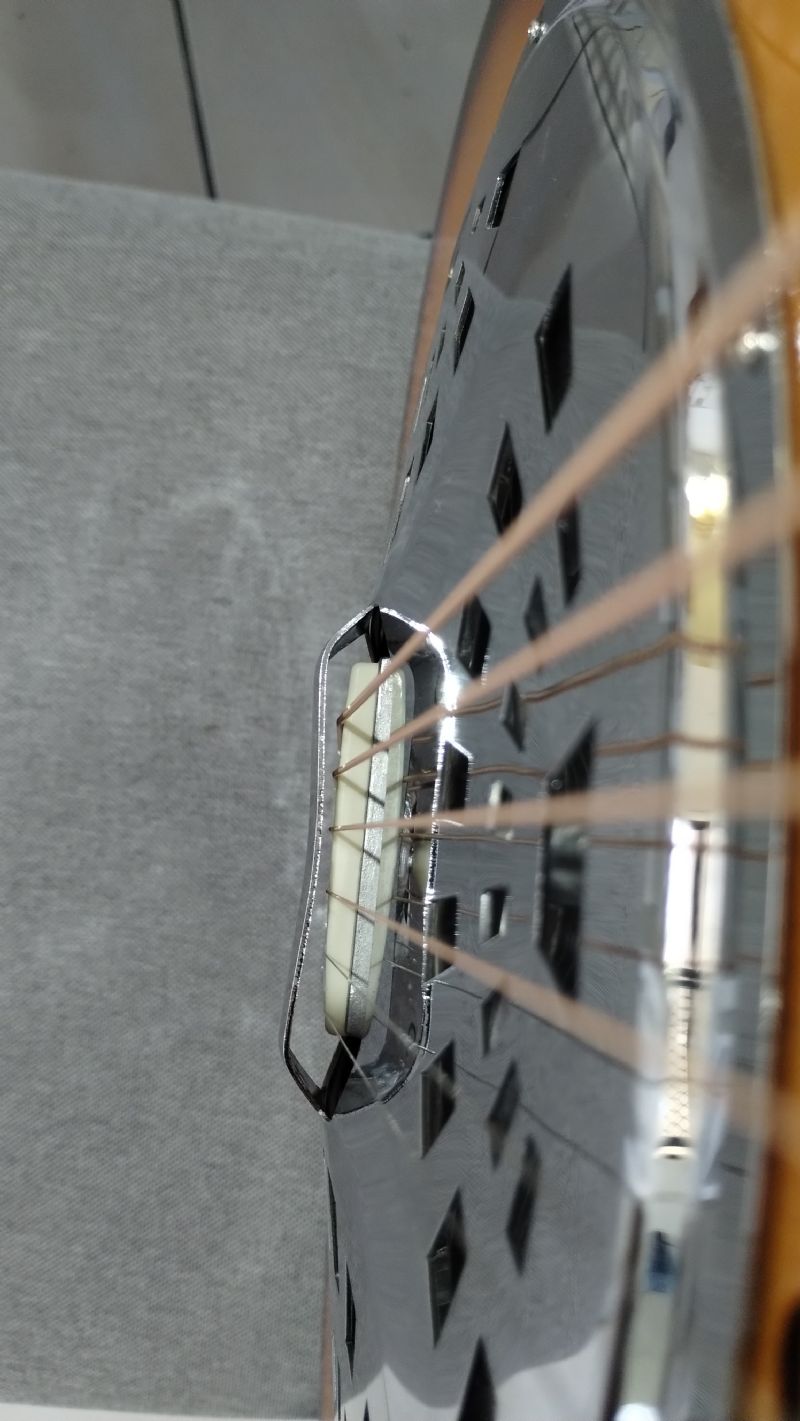
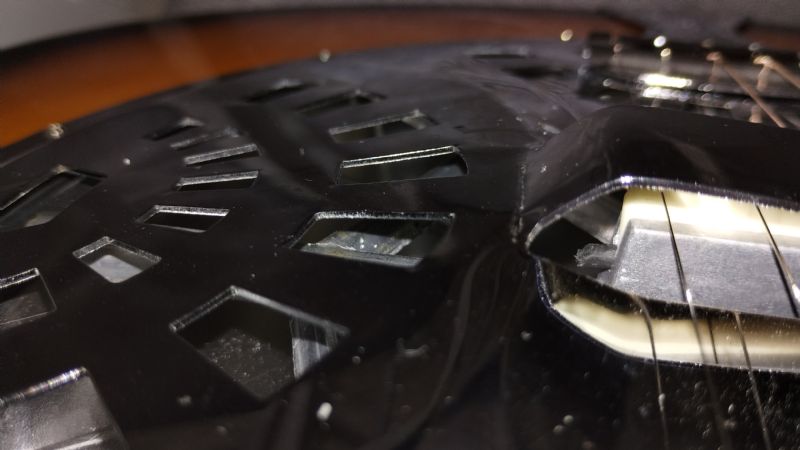
I am fairly new to resonators, so I may have the wrong idea here, but, looking at how the tension screw adjustment is described on some websites, it seems as though it is assumed the strings are all on and tuned up while it is done. I see some saddles are two pieces, leaving a gap for access to the tension screw. However, the saddle on mine is one piece and so obstructs the hole in the centre for the tension screw.
Is this common? Should I get a two piece saddle, or do many/most just set the tension screw approximately, then put the saddle in place and and string the guitar, not worrying about fine adjustment.

….trouble with that arrangement that the saddle should be press fit into the spider unless it’s held with screws like Beard’s adjustable spider bridge. You can’t press the bridge to the spider while it’s attached to the cone. Perhaps a photo of what you have will help with the answer.

Adding to what Eric wrote, a one piece saddle/bridge insert is incorrect for a spider bridge reso because you have no access to the tension screw once installed.
Here is a source of possible confusion: Replogle Resos in the SF Bay Area for example sells once piece saddles that can be used for biscuit bridge resos or spider bridge guitars. For biscuit bridge, they are used as is - once piece. For spider bridge they need to be cut in half for two separate inserts so that one can access the tension screw in the middle.
There is such a thing as an offset spider where I suppose a one piece saddle would work because the tension screw hole is adjacent to the bridge slot, and the saddle doesn't cover the tension screw. These were first used by the Dobro company back in the 1930s to correct intonation issues on certain guitars. In modern times Beard Guitars sells them on their Resophonic Oufitters website as they are often used for seven string resonators.
Edited by - MarkinSonoma on 09/03/2026 11:27:19
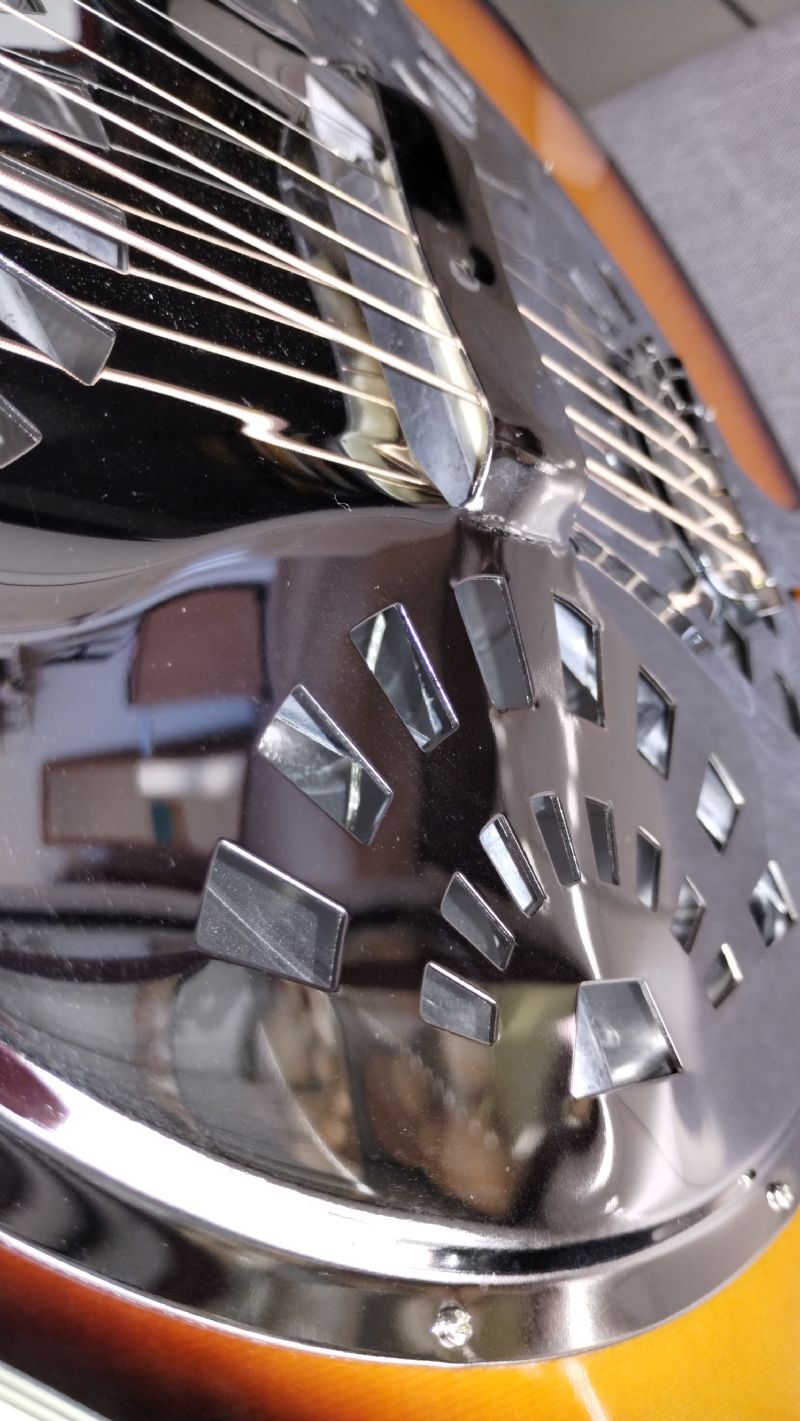
Here's a photo. I have a suspicion that this has happened because this cheap guitar has a built in piezo electric pickup, same type as used in many cheap acoustics. I wonder if they used a typical under bridge piezo bar pickup. This would have to be one piece, hence they used a one piece bridge on top of it.
quote:
Originally posted by MarkinSonomaFor biscuit bridge, they are used as is - once piece. For spider bridge they need to be cut in half for two separate inserts so that one can access the tension screw in the middle.
That did help me understand the bridges I see for sale. Thanks.
I suspect you'll have to take the guitar apart to see exactly what you're dealing with.
Is it normal? No!
Is it correct? No!
h
quote:
Originally posted by hlpdobroI suspect you'll have to take the guitar apart to see exactly what you're dealing with.
Is it normal? No!
Is it correct? No!
h
Yes. I didn't mention the guitar brand because it is a local name in Australia. It has Karrera on the headstock, but it looks identical to what is sold in the US under the Pyle name. So it's a very cheap guitar out of China I guess.
That said, the construction and finish was superb. The action was only a little high, and all the frets are buzz free. The binding is very neat, the wood finish is blemish free. Tuners could be improved on but they work OK. The strings were rough and squeeky, so I replaced them straight up. I generally use Elixir phosphor bronze, I had a set spare, so that's what I used. The guitar plays really nicely now.
I could easily put the correct bridge on it I suspect. The piezo pickup system they have "invented" does not sound realistic at all. Harsh and peaky (like a lot of cheap acoustic pickup systems), so it's not something important to me.
Update: Peering through the holes in the cover plate I can now clearly see the heatshrink coated piezo bar sitting under the bridge saddle protruding from end slightly. I can also see the shielded wire coming from the other end of the bar going off to the preamp.
Edited by - CheapRes on 09/03/2026 20:34:39
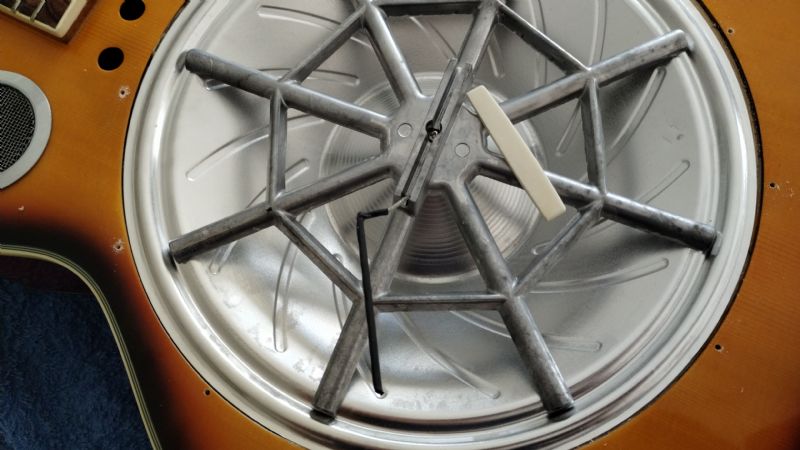
Right, so I had to know. I pulled it apart and took pictures. It is as it looked from the outside, a one piece plastic saddle sitting on a piezo bar. It is a loose fit in the slot.
While I had it apart, I tightened the tension screw just a little bit, then put it all back together. Gone is the one bit of fuzziness on the bass string, and I think the general sound is fuller and nicer.
Time to do all this was about a half hour, including a small adjustment to the truss rod, so not too bad. I can understand some luthiers saying you don't really need to use a two piece bridge. I doubt I'll need to reset the tension screw for a long time.
Did "some luthiers" also drill a hole in the cone?
You're getting the sound you like, good!
fwiw, You may not be able to replace the bridge inserts with standard components on that guitar. I can't tell by the photos if the spider bridge is slotted too wide (common with Asian imports). Also, fwiw, if you eventually order new inserts just be aware that the pre-slotted components are for lap style/square neck guitars only. You'll be needing insert "blanks" to be slotted for your preferred string spacing.
Have fun.
h
quote:
Originally posted by hlpdobroDid "some luthiers" also drill a hole in the cone?
You're getting the sound you like, good!
fwiw, You may not be able to replace the bridge inserts with standard components on that guitar. I can't tell by the photos if the spider bridge is slotted too wide (common with Asian imports). Also, fwiw, if you eventually order new inserts just be aware that the pre-slotted components are for lap style/square neck guitars only. You'll be needing insert "blanks" to be slotted for your preferred string spacing.
Have fun.
h
I have ordered some inserts to experiment with. We will see when they arrive, how well they fit. They aren't pre-slotted, but I have a good set of nut files and fine saws, so I can easily do that myself. btw. the existing bridge is not slotted at all, and the guitar plays fine with no buzzing -maybe because it is plastic, but then my experience with wooden floating bridges on jazz guitars, is that wood does not buzz.
Terms of Use | Privacy Policy | Privacy Consent (EU/GDPR Only)
Copyright 2026 Reso Hangout. All Rights Reserved.