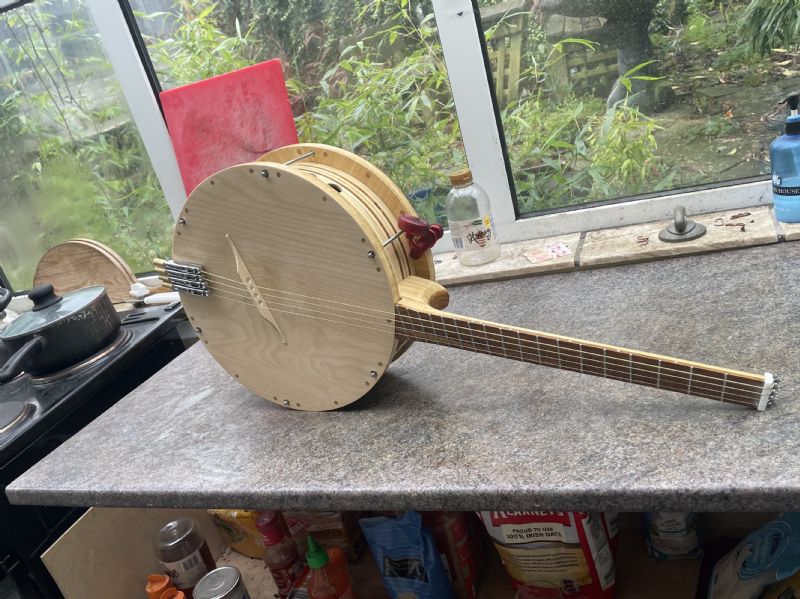
Supposing you have a square neck guitar with a circular wooden top that has no bracing at all. To prevent the top from sagging it is stressed under tension. To prevent the top from spitting it is an aircraft grade birch plywood. This top is somewhere between 1 & 2 millimetres thick. You might have a very loud slide guitar, as loud as a resonator maybe? I think it could be good.

1-2 mm is mighty thin. The ukuleles I make start at about 0.065 for hardwood tops, koa, and about 0.080 for soft, spruce and cedar. I'm of a mind that there would be some serious destruction at those thicknesses. 0.080 is right at 2 mm. These thickness are subject to little tests/feel I do with my hands and can increase.
But Hey, I've been wrong plenty of times.
As an edit, I have never built a resonator guitar. Lots of ukes, maybe half a dozen E guitars, an odd mando (an F5, I lost my mind) or two. I am fixin to start a lap steel and I've never built one of them.
Edited by - Terry Harris on 10/03/2026 18:49:41

quote:
Originally posted by Terry Harris1-2 mm is mighty thin. The ukuleles I make start at about 0.065 for hardwood tops, koa, and about 0.080 for soft, spruce and cedar. I'm of a mind that there would be some serious destruction at those thicknesses. 0.080 is right at 2 mm. These thickness are subject to little tests/feel I do with my hands and can increase.
But Hey, I've been wrong plenty of times.As an edit, I have never built a resonator guitar. Lots of ukes, maybe half a dozen E guitars, an odd mando (an F5, I lost my mind) or two. I am fixin to start a lap steel and I've never built one of them.
Like yourself Terry I haven’t built a resonator guitar yet (I have converted one to 5 string banjo tuning). I have made 50 banjo's so I'm aiming for 'loud'. I actually made a tenor guitar over last Christmas that has a 1.6mm top zero bracing and that hasn't budged in the last 10 months and I haven't adjusted its tension in that time. It is loud but not as loud as a banjo and surprisingly the top reacts the same way a banjo does in relation to bridge placement. I was incorrectly assuming it would vibrate like a guitar top. I have a tenor resonator guitar tuned in fifths and this has more volume.
Would you necessarily have to build a complete guitar in order to experiment with top thicknesses? When I was at university and also in the field I did testing on prestressed concrete and sizing various wood products. Most of this was performed on models of real life applications. This was, at first, prior to computer analysis.
quote:
Originally posted by skydogWould you necessarily have to build a complete guitar in order to experiment with top thicknesses? When I was at university and also in the field I did testing on prestressed concrete and sizing various wood products. Most of this was performed on models of real life applications. This was, at first, prior to computer analysis.
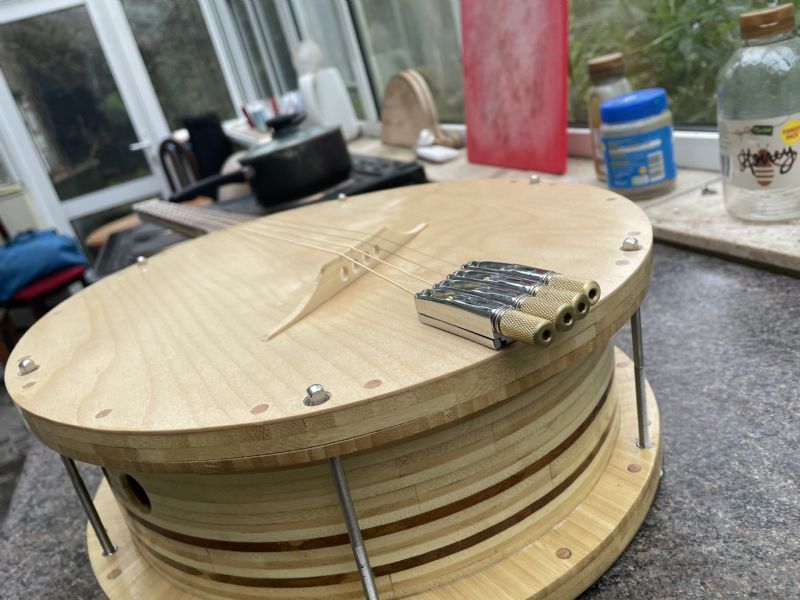
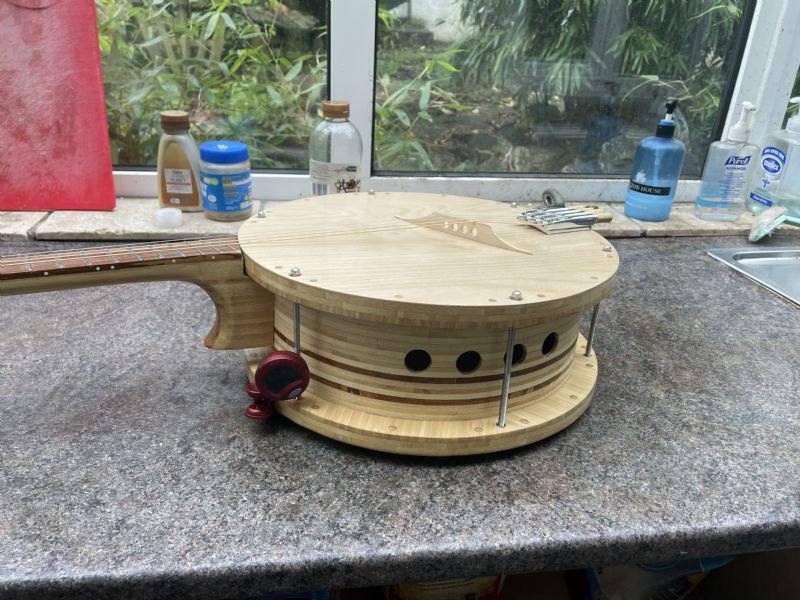
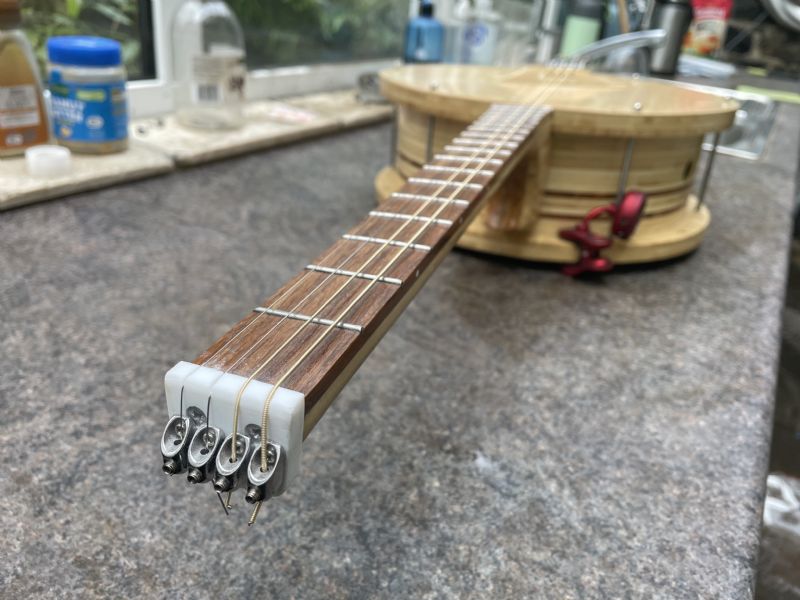
I have started on some 6 strings and I'm also working a bouzouki version. I only have two thicknesses of aircraft plywood 1.6mm and 2.5mm so I'll be running combinations of the two. The tenor guitar that I made has 1.6mm for the top and the back has thin bendy ply from the local hardware store a little thinner (and a lot cheaper). I'm planning on taking it apart and resetting the neck so it runs through the body about 1/2" off center to improve the tonal balance. A slide version will run through the center you can see the tension system in the photo it has a series of side ports on the top side
I've never built an instrument, but I have spent a lot of time (probably too much time) learning about top bracing and speaking with a handful of accomplished luthiers about it over the years.
Bracing on an acoustic flattop, be it solid wood, or laminate on an inexpensive guitar plays a huge role and performs multiple tasks.
I have my doubts that no bracing, even with aircraft grade birch plywood would make for a pleasing guitar.
You’re right. The overall sound is only ok. When I play individual notes like flat picking a melody it sounds good, but when I strum out some chords it sounds like a cheap guitar. Out of balance. I’ve figured the reason for this is because the bridge is uneven with the perimeter of the top. As the bridge gets closer to the perimeter or edge of the top the tone gets brighter and so obviously it gets darker when the bridge is set further away from the edge. This guitar is fan fretted so the bridge is totally uneven to the edge. The bass end of the bridge is quite close to the edge and the treble end is considerably farther away. When I make a slide version it won’t be fan fretted so the bridge will be square and even. Actually due to it being a floating bridge there will be the ability to alter the tone to taste. I got caught out thinking guitar top but without the bracing and importantly with the perfectly round shape it actually reacts exactly like a banjo but with a guitar sound. And it is LOUD!
Terms of Use | Privacy Policy | Privacy Consent (EU/GDPR Only)
Copyright 2026 Reso Hangout. All Rights Reserved.